

⏱ Estimated reading time: 4 min read
A football route tree is a teaching chart that gives common receiving paths names and, in some systems, numbers. Read any route as stem, break and target: the receiver’s initial path, the change of direction and the window where the quarterback intends the ball to arrive.
The numbers below are one teaching convention, not a universal NFL language. A coach can use different numbers, different names or a different depth for the same basic shape. The useful skill is recognizing the receiver’s direction in relation to the field and the other routes.
Inside and outside stay relative to the field
Every route in the nine-panel chart starts with X wide left, viewed from behind the offense. Downfield is up. Outside means toward the nearby sideline, to the left of the screen here. Inside means toward the middle, to the right. Mirror X to the right side and those screen directions reverse: an out still goes toward the sideline.
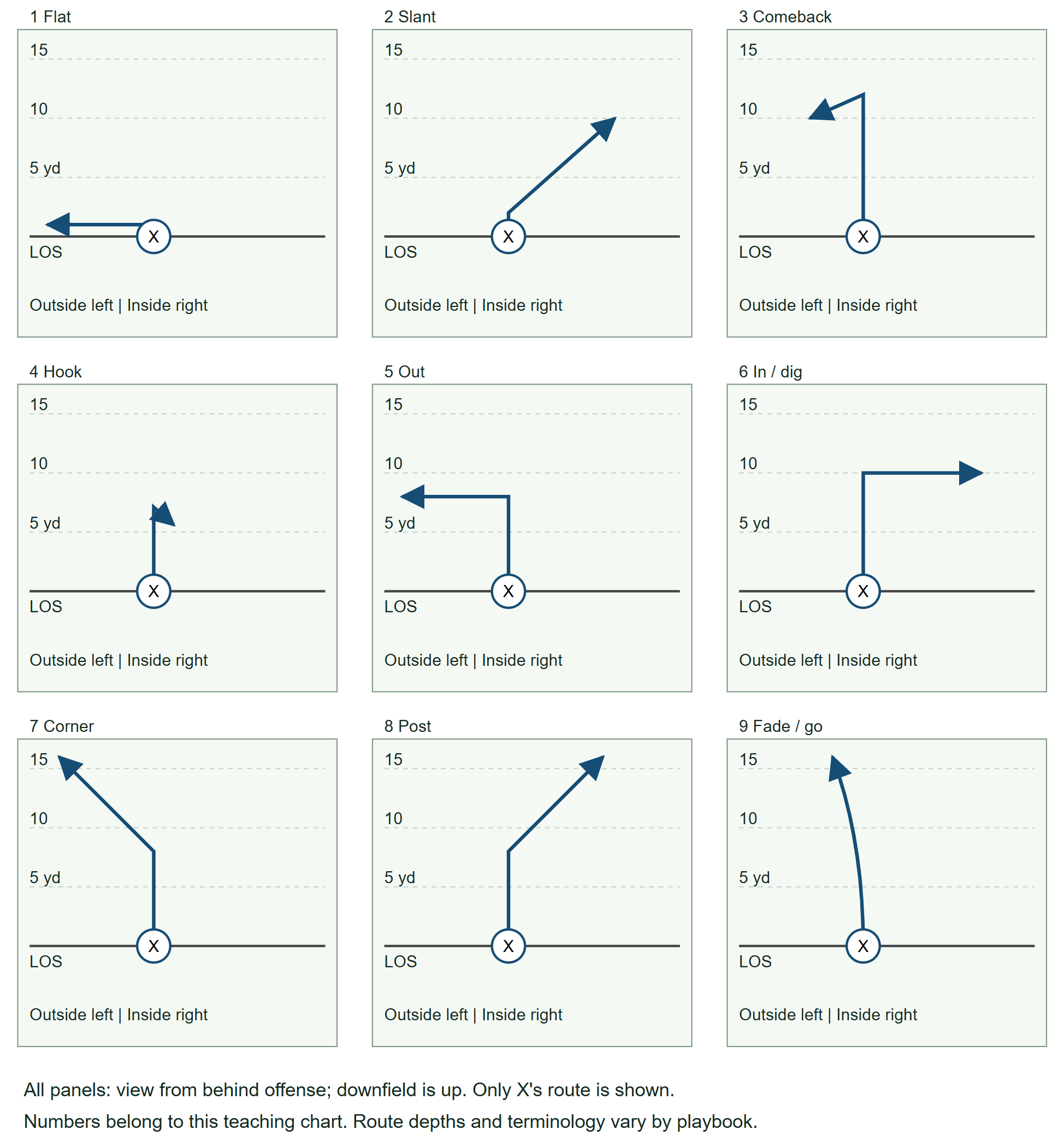
| Number and name | Recognizable action | What distinguishes it? |
|---|---|---|
| 1: flat | Release toward the nearby sideline at short depth | It attacks width quickly. |
| 2: slant | Break diagonally inside after a short stem | It continues across the field on an angle. |
| 3: comeback | Push vertically, then return toward the outside and quarterback | The final path gives back some depth. |
| 4: hook | Stem upfield, then turn into a defined settling area | The receiver presents a target rather than continuing across. |
| 5: out | Stem upfield, then break toward the sideline | The break creates a lateral outside path. |
| 6: in / dig | Stem upfield, then break toward the middle | The lateral path runs inside. |
| 7: corner | Stem, then angle toward the deep outside | It keeps gaining depth after the break. |
| 8: post | Stem, then angle toward the deep middle | It attacks inside at a downfield angle. |
| 9: fade / go family | Attack vertically, with the release and track set by the call | The family emphasizes a vertical threat, with technique variations. |
Stem, break and target are three separate decisions
The stem sets up the defender. The break changes the receiver’s path at the called depth. The target is where the throw should meet the receiver, which is not necessarily where he was when the quarterback began throwing. A crisp-looking route can still be a poor throwing option if a defender occupies that target window.
Consider an out route designed to break at 8 yards from a shotgun formation with X wide left and an offset RB. The cropped panels show only X, QB, RB and the starting cornerback, not the full offense or defense.
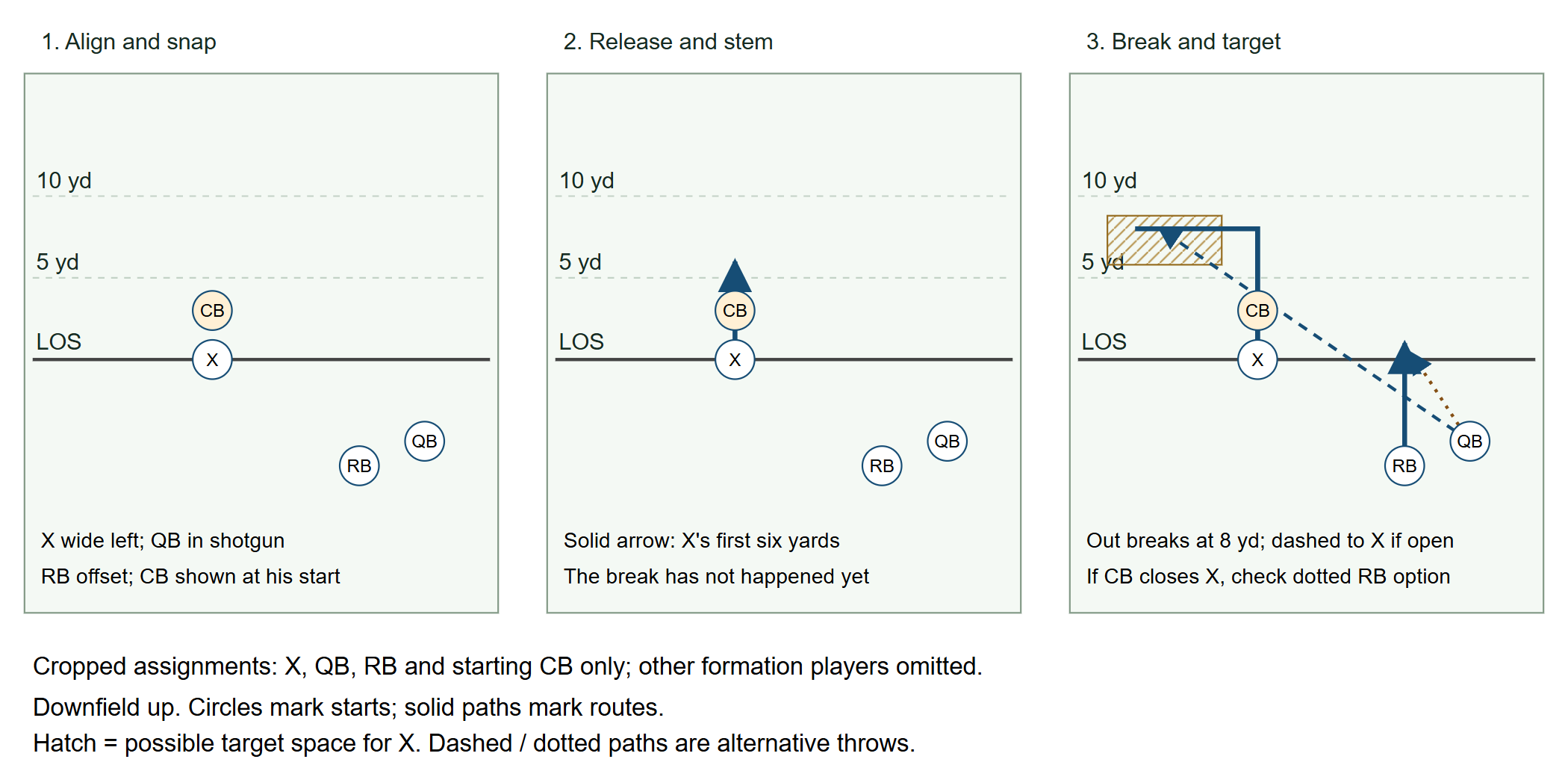
- Align and snap. X begins wide left. QB receives the shotgun snap. The corner’s starting position gives an initial clue but does not decide where he will go.
- Release and stem. X works vertically. In the second frame he has reached 6 yards and has not yet made the 8-yard break. QB watches how the coverage develops.
- Break and choose the window. X turns outside at 8 yards. If the outside window is available, QB throws toward it. If the corner takes that window, QB moves to the called checkdown, represented here by RB releasing short.
The checkdown is part of this teaching progression, not a guarantee that a back is available on every pass. A back may have to remain in protection, and a different concept can give the quarterback a different next read.
A route tree is smaller than a passing concept
A concept coordinates multiple routes with protection and a quarterback’s read. A crossing route can pull one defender away from another target; a vertical route can create room below it. Naming a single route does not tell you how the whole play solves coverage.
The numbering convention comes from the NFL FLAG teaching lesson, page 31. That youth chart is useful vocabulary, not an 11-player NFL playbook or a claim that every high school teaches identical terminology. USA Football’s explanations of progression passing and Y cross show how coaches connect individual paths into reads.
For NFL pass legality, use Rule 8 of the 2026 NFL rulebook. A diagram explains the route; it does not by itself establish receiver eligibility, legal contact or a legal forward pass.