
⏱ Estimated reading time: 5 min read
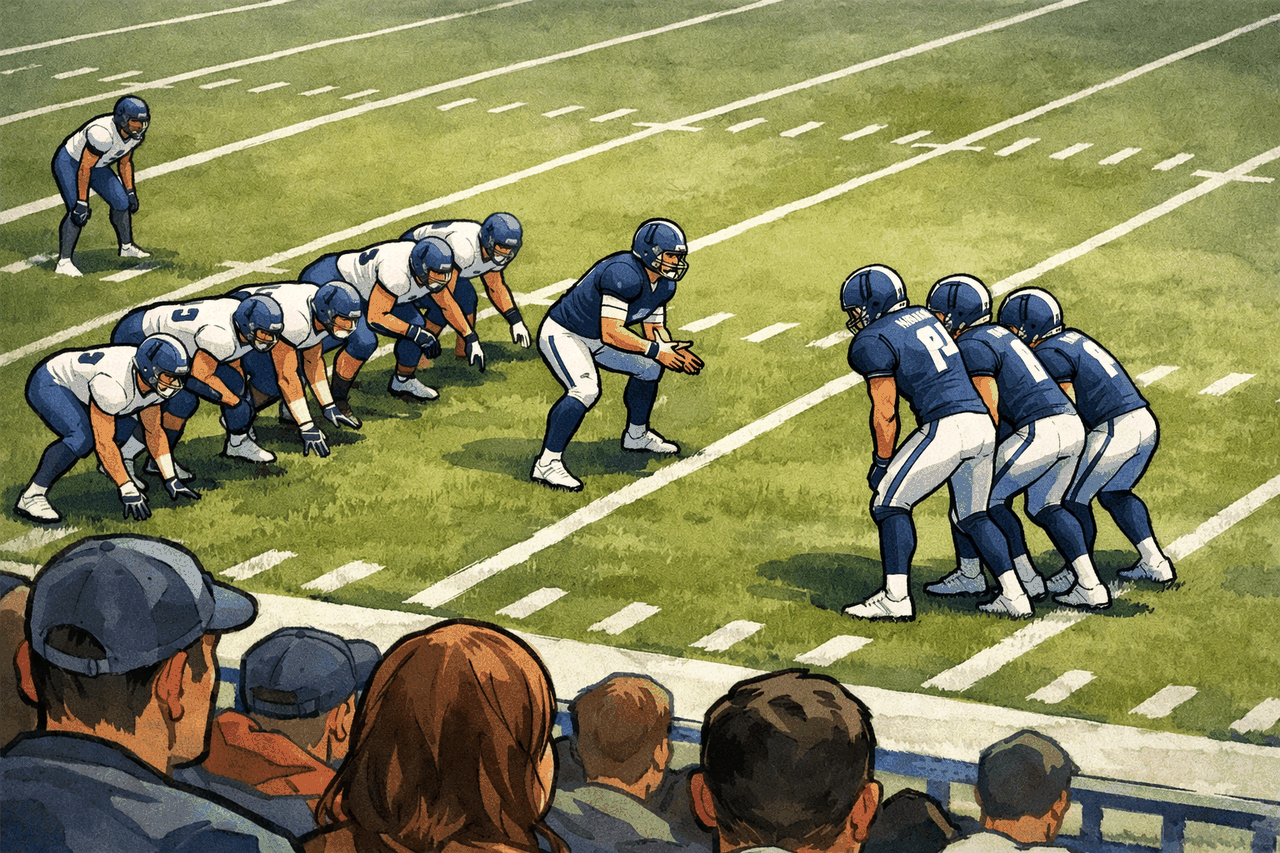
An offensive formation is the arrangement of players before the snap. It tells you where the quarterback, backs, tight ends and receivers begin, but it does not tell you the entire play. The same group can line up under center, spread into trips or gather into a bunch, then run several different concepts from each look.
Start by finding the center and counting the players on either side. The three panels here keep the personnel constant: five offensive linemen, one quarterback, one running back, one tight end and three wide receivers. That is 11 personnel. Only the distribution and selected play assignments change.
Personnel, formation and system answer different questions
| Label | Question it answers | Example here |
|---|---|---|
| Personnel | Which types of players are on the field? | 11 personnel: 1 RB, 1 TE, 3 WR, plus QB and 5 OL |
| Formation or distribution | Where do those players start? | Balanced, trips right or bunch right |
| Offensive system | Which concepts and teaching principles organize the attack? | A repeatable approach to runs, protection and route combinations |
X and Z are outside-receiver labels, W is the third receiver and Y is the tight end. They remain the same players when moved. A formation change does not automatically require a substitution, and one formation does not identify a team’s entire offensive system.
1. Under center, balanced distribution
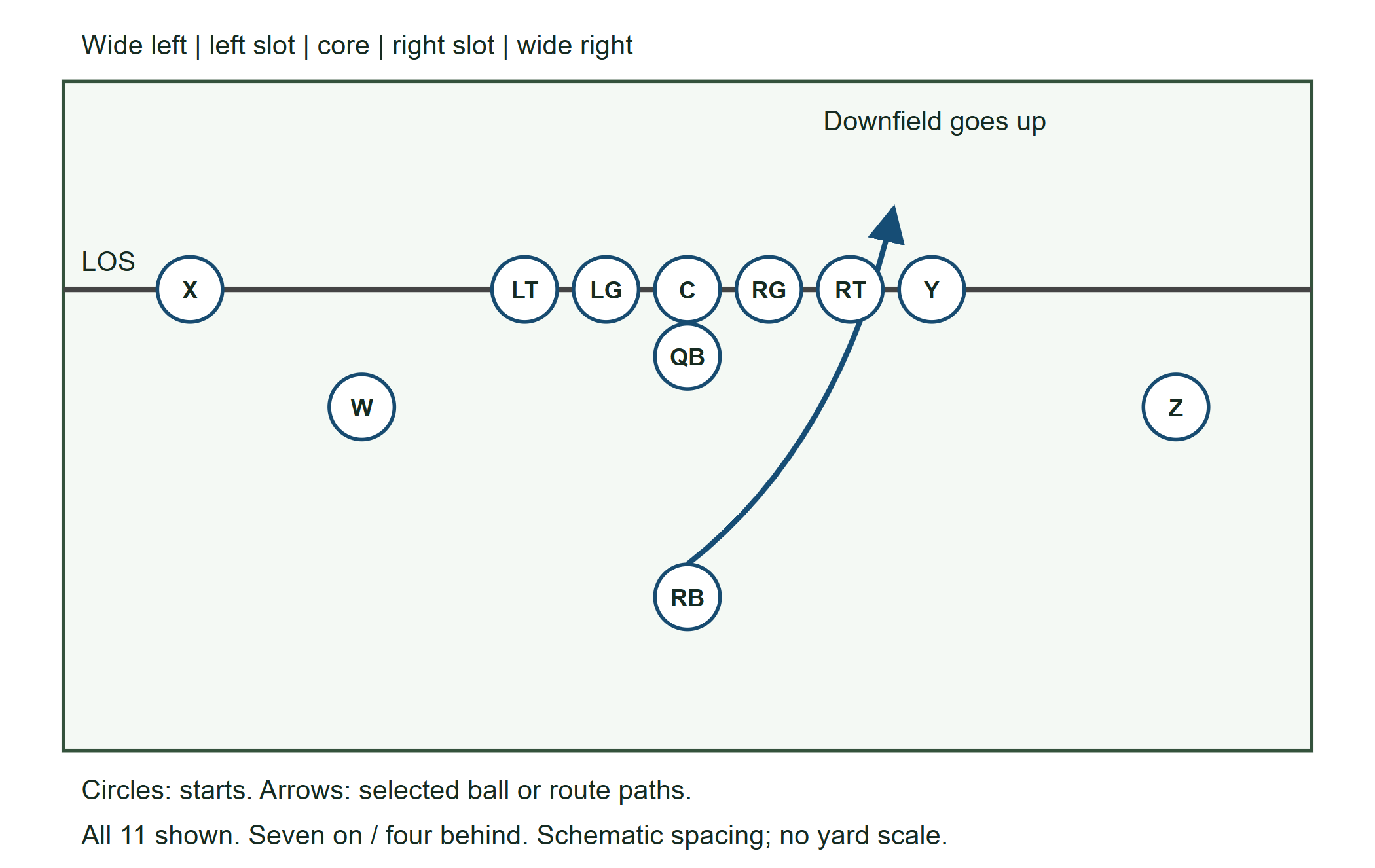
The quarterback begins directly behind the center, with the running back deeper. X and W provide two receiving threats to the left; attached Y and wide Z provide two to the right. “Balanced” describes that distribution here, not a promise that every possible definition of balance uses identical spacing.
For the example run, QB takes the snap and hands to RB. RB aims toward the right-side blocking surface and chooses his lane from the blocks. Y extends that surface beyond RT. The receivers have blocking jobs rather than routes on this call.
2. Shotgun, trips right
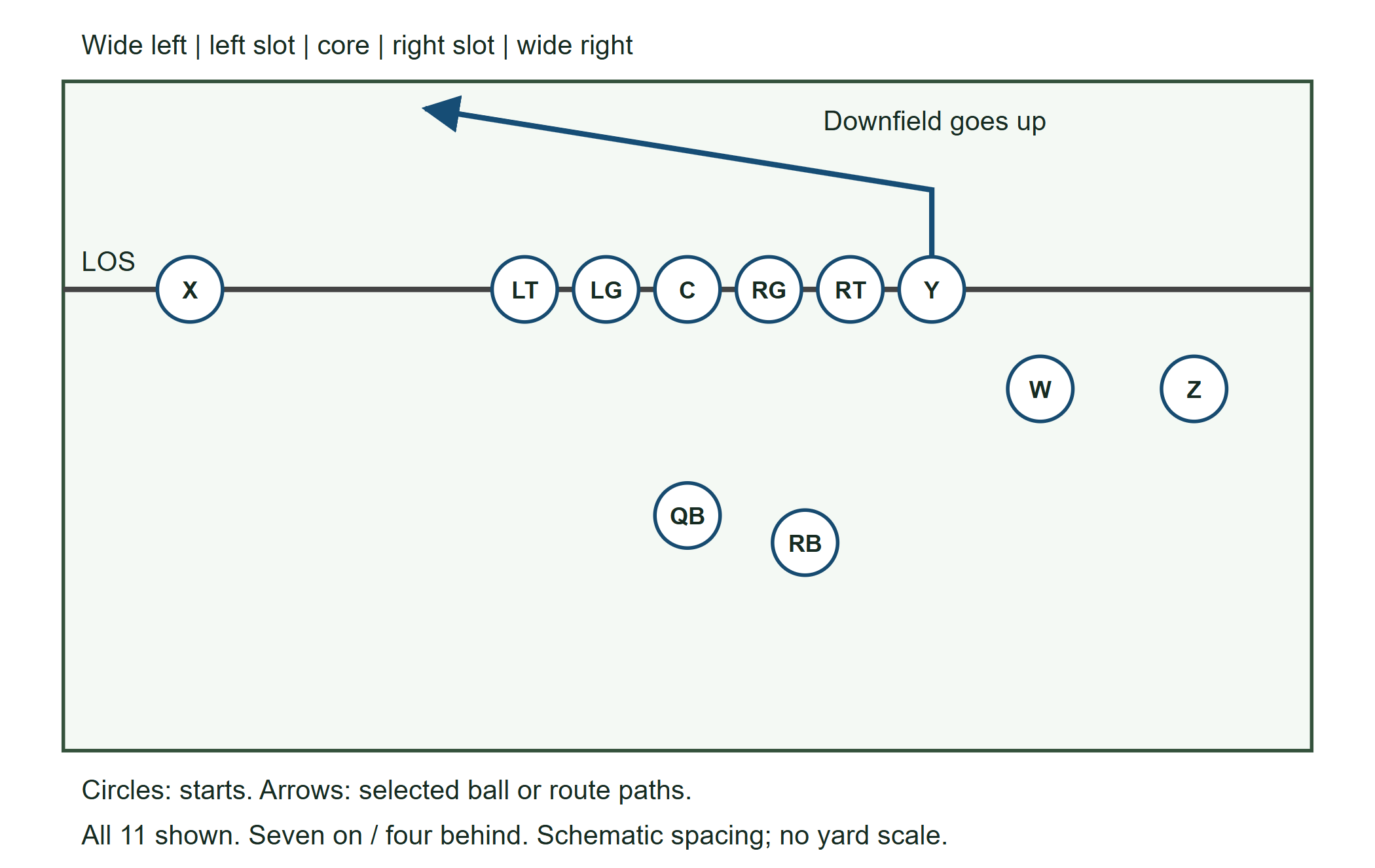
The quarterback is now back from the center to receive the snap in shotgun, with RB offset. Moving W to the right creates trips without changing personnel. Y is still attached and on the line, and W and Z remain behind it.
The example is a Y-cross teaching call. Y releases upfield and crosses toward the opposite side. The other receivers create complementary space: X runs vertically, W offers a short outlet and Z takes a deeper outside path. QB reads the called progression while RB checks his protection responsibility. These are assigned teaching roles, not a claim that every Y-cross play uses one universal route combination.
3. Bunch right
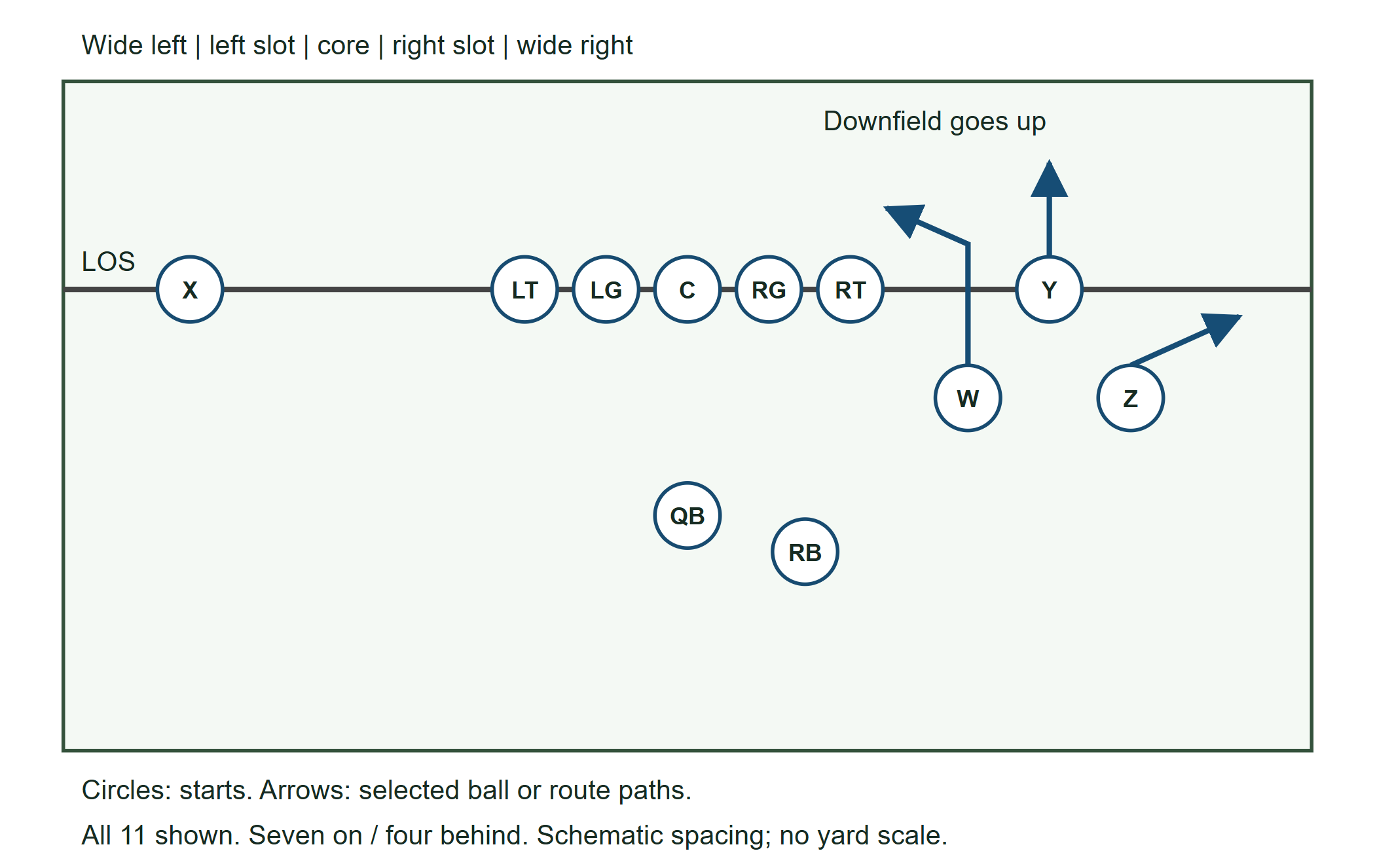
Bunch compresses the starting separation among three eligible receivers. It can make their releases and the defense’s handoffs easier to see as a group. Here Y is detached from the tackle, but he remains the right end of the line. The space between RT and Y does not add another player.
On the quick-spacing example, Y pushes upfield to occupy a defender, W settles inside and Z releases toward the flat. QB checks the called short options, while RB carries out the protection assignment. The drawing illustrates separation into different spaces; it does not authorize receivers to block defenders while an illegal pass play develops.
| Players | Balanced run | Trips Y cross | Bunch spacing |
|---|---|---|---|
| LT, LG, C, RG, RT | Execute the called run blocks; C also snaps | Execute pass protection; C snaps | Execute pass protection; C snaps |
| QB | Receive snap and hand off | Read the crossing concept | Read the short spacing options |
| RB | Take handoff and read the right-side blocks | Check assigned protection, then release if called | Handle assigned protection |
| Y | Block at the right edge | Run the crossing route | Push upfield |
| X | Block the assigned outside defender | Run vertically | Run the backside route |
| W | Block the assigned support defender | Offer a short outlet | Settle in the inside space |
| Z | Block the assigned outside defender | Run the deeper outside route | Release to the flat |
Count the line before judging eligibility
Each panel has seven on the line and four behind: LT, LG, C, RG, RT, X and Y are on; QB, RB, W and Z are off. The ordinary eligible receiving locations are the two ends of the line and legal backfield positions at least one yard behind it when the ball is snapped. Eligible numbers or legal reporting also apply. The under-center quarterback shown in the first panel takes a T-formation stance and is ineligible there. Rule 8-1-6(d) specifies how he can move to an eligible spot and remain stationary for at least one second before the snap.
These panels show settled formations, not several receivers moving simultaneously at the snap. Shifts and motion have additional requirements. For formation legality, motion and pass eligibility, use 2026 NFL Rules 7-4, 7-5-1 and 8-1-5/6.
For examples of concepts taught from formations, USA Football’s Y-cross and scan-read explanation and power-option example provide coaching context. The panels here are original teaching illustrations, not footage, tested plays or a reproduction of an NFL team’s call sheet.