
⏱ Estimated reading time: 4 min read
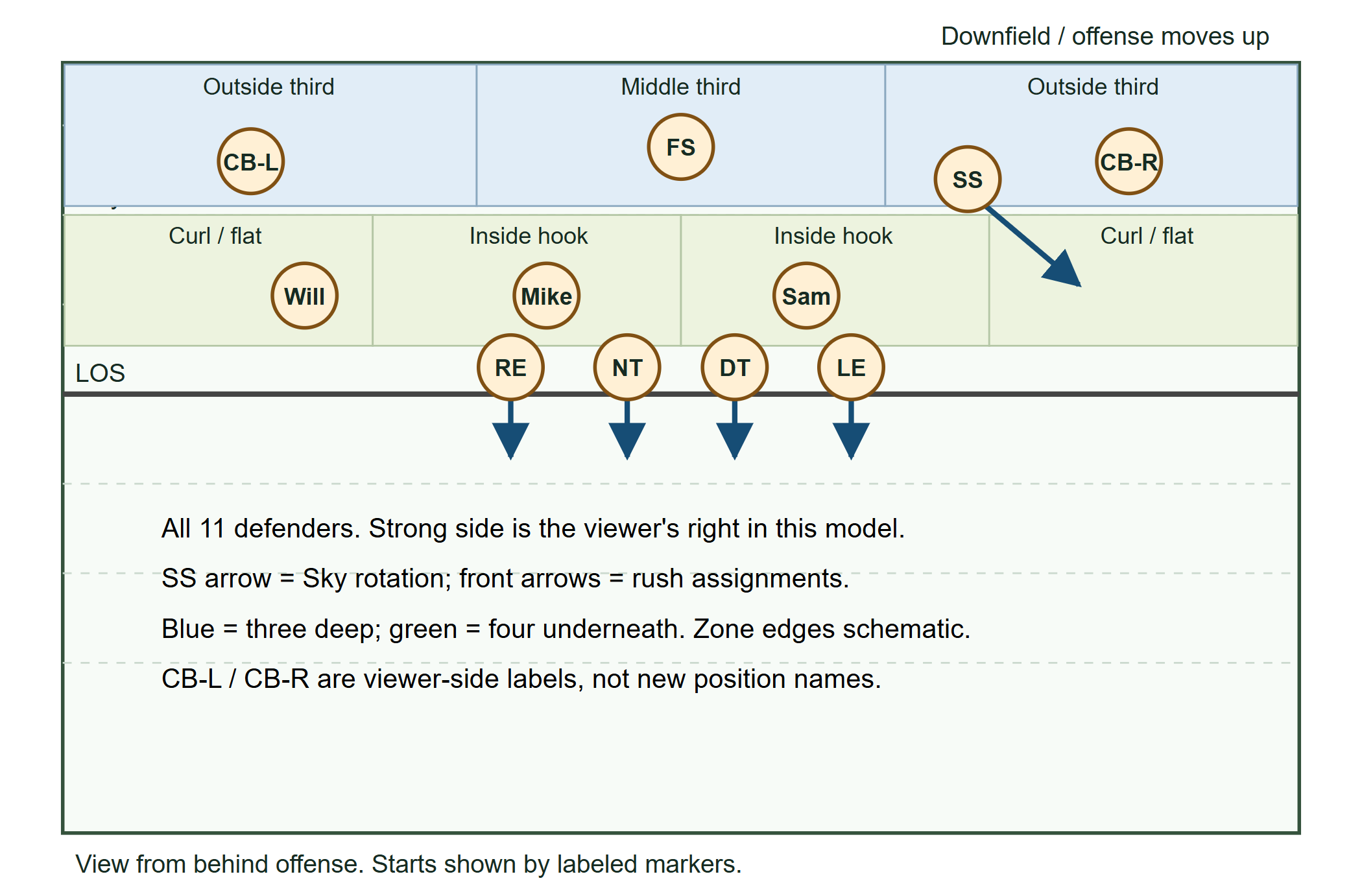
Cover 3 puts three defenders across the deep field, usually an outside corner on each side and a safety in the middle. In the spot-zone model here, four defenders work underneath and four rush. The deep defenders keep vertical routes in front, while the underneath defenders respond to routes entering their areas.
The illustrated version uses a Sky rotation: a safety comes down to an outside underneath responsibility. That tells you who fills one short-area job; it does not change the coverage into something other than three deep. Team naming systems vary, so always identify the actual assignments.
The full 11-player map
| Defender | Responsibility | Main relationship to preserve |
|---|---|---|
| CB-L | Left outside third | Stay above outside vertical threats and connected to FS inside. |
| CB-R | Right outside third | Cushion the outside vertical threat rather than chasing a short route down. |
| FS | Middle third | Protect the deep middle and respond to routes entering it. |
| SS | Rotate to strong right curl-flat | Connect the outside short area to Sam’s inside coverage. |
| Will | Opposite curl-flat | Handle the left outside underneath area. |
| Mike and Sam | Inside hooks | Respond to interior routes without both chasing the same threat away from the middle. |
| RE, NT, DT, LE | Four rush assignments | Execute the called rush lanes against protection. |
The count is three deep, four underneath and four rushing: 11. The front labels describe this chosen personnel picture. A team can change front personnel or underneath allocations and still finish with three deep defenders.
A two-route case: who cushions and who drives?
Use the offense’s right side. The outside receiver goes vertically while the inside receiver releases into the flat. CB-R cushions the vertical route, keeping depth between that receiver and the end zone. SS, rotating into the curl-flat, reads the outside underneath threat. Sam works the inside hook rather than following the flat receiver across SS’s entire area.
| What develops? | Defensive reaction | What must remain covered? |
|---|---|---|
| Outside vertical and inside flat routes separate | CB-R gains depth with the vertical threat; SS relates to the flat | The outside third stays above the short route. |
| The short throw is declared and SS has leverage | SS drives toward the flat target | CB-R preserves deep support; Sam stays aware of the inside hook. |
| The flat route is a decoy and QB continues holding the ball | SS avoids a blind early jump; CB-R keeps his cushion | The space between the underneath and deep defenders remains connected. |
| A third, intermediate outside route joins the pair | The defense must distribute three depths with the called help and spacing | SS cannot cover both the flat and intermediate target at once. |
That last row is the limit. If SS drives down and CB-R is held deep, an intermediate window may develop between them. The call’s spacing, pressure and route distribution affect whether the offense can use it. The words Cover 3 do not guarantee that every route on one side has its own defender.
What Sky adds to the description
| Description | What it tells you | Why the distinction matters |
|---|---|---|
| Spot-zone Cover 3 base | Three deep areas, with underneath defenders working zones | It identifies the broad coverage structure, not every player’s rotation. |
| Cover 3 Sky in this naming system | A safety fills down to an outside underneath area | SS’s movement changes which player reads and closes on the flat. |
| Another three-deep allocation | The same deep count can coexist with different underneath jobs | Do not assign SS this exact role from the deep count alone. |
A one-high post-snap picture helps identify the middle-third safety, but pre-snap appearances can disguise the rotation. Watch the safeties after the snap, then locate the outside underneath defenders. That sequence is more useful than naming the coverage from one frozen image.
Where the basic model stops
Match versions add route-dependent carrying and handoff rules. They can start from similar landmarks yet behave differently when receivers release vertically or cross. This article stays with the spot-zone base. Likewise, offensive combinations that attack its windows are a separate question from learning who owns each zone.
The teaching foundation is USA Football’s basic coverage explanation. The Eagles’ 2018 Titans-game film discussion supplies a documented deep-and-underneath example. Coaching terminology can be compared with the Cover 2 Read account, while the Rip/Liz discussion marks the boundary with route-matching rules. None makes one naming system universal.