
⏱ Estimated reading time: 5 min read
On offense, the quarterback directs the play, eligible receivers and backs move the ball, and the offensive line creates room or protects the passer. On defense, the front attacks blocks and running lanes, linebackers connect the front to coverage, and defensive backs defend receivers and open space. Each side has 11 players on the field. A position name describes a usual job; the assignment on a particular snap tells you what that player actually does.
Use the two maps below to locate those jobs before following the ball. They show one offense and one defense, not a required alignment for every team.
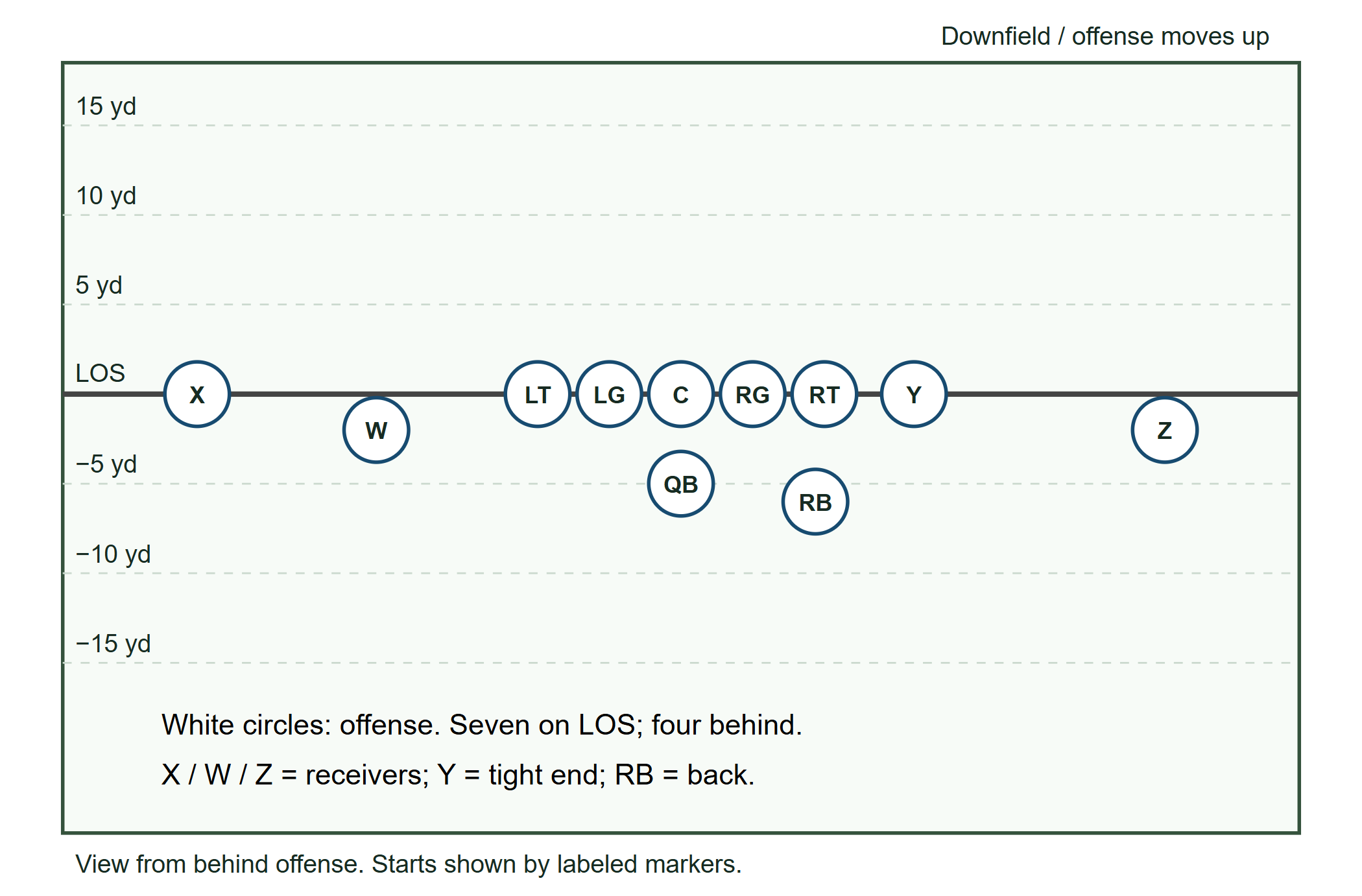
The 11 offensive positions in this example
This offense uses 11 personnel: one running back, one tight end and three wide receivers, along with the quarterback and five offensive linemen. Count the alignment separately from those personnel labels. Here, seven players are on the line of scrimmage and four are behind it.
| Player | Start | Run to the right | Pass |
|---|---|---|---|
| C: center | Middle of the line, over the ball | Snap, then block an interior defender | Snap, then protect inside |
| LG / RG: guards | Immediately beside C | Open the called interior lane | Protect inside rush lanes |
| LT / RT: tackles | Outside the guards | Control the edge of the blocking surface | Protect against outside rushers |
| QB: quarterback | Behind C | Receive the snap and hand off | Read coverage and deliver the ball |
| RB: running back | Offset behind the line | Take the handoff and read the block | Check protection, then release if assigned |
| Y: tight end | Attached outside RT, on the line | Block the right edge | Release into a called route |
| X: receiver | Wide left, on the line | Engage the assigned outside defender | Run the left outside route |
| W: slot receiver | Inside X, behind the line | Block the assigned support defender | Work an inside route |
| Z: receiver | Wide right, behind the line | Block the assigned outside defender | Run the right outside route |
The paired guard and tackle rows each represent two different players. The map contains all five linemen, plus six other players, for 11 total. A tackle here is an offensive lineman; a defensive tackle is a different role on the other side of the ball.
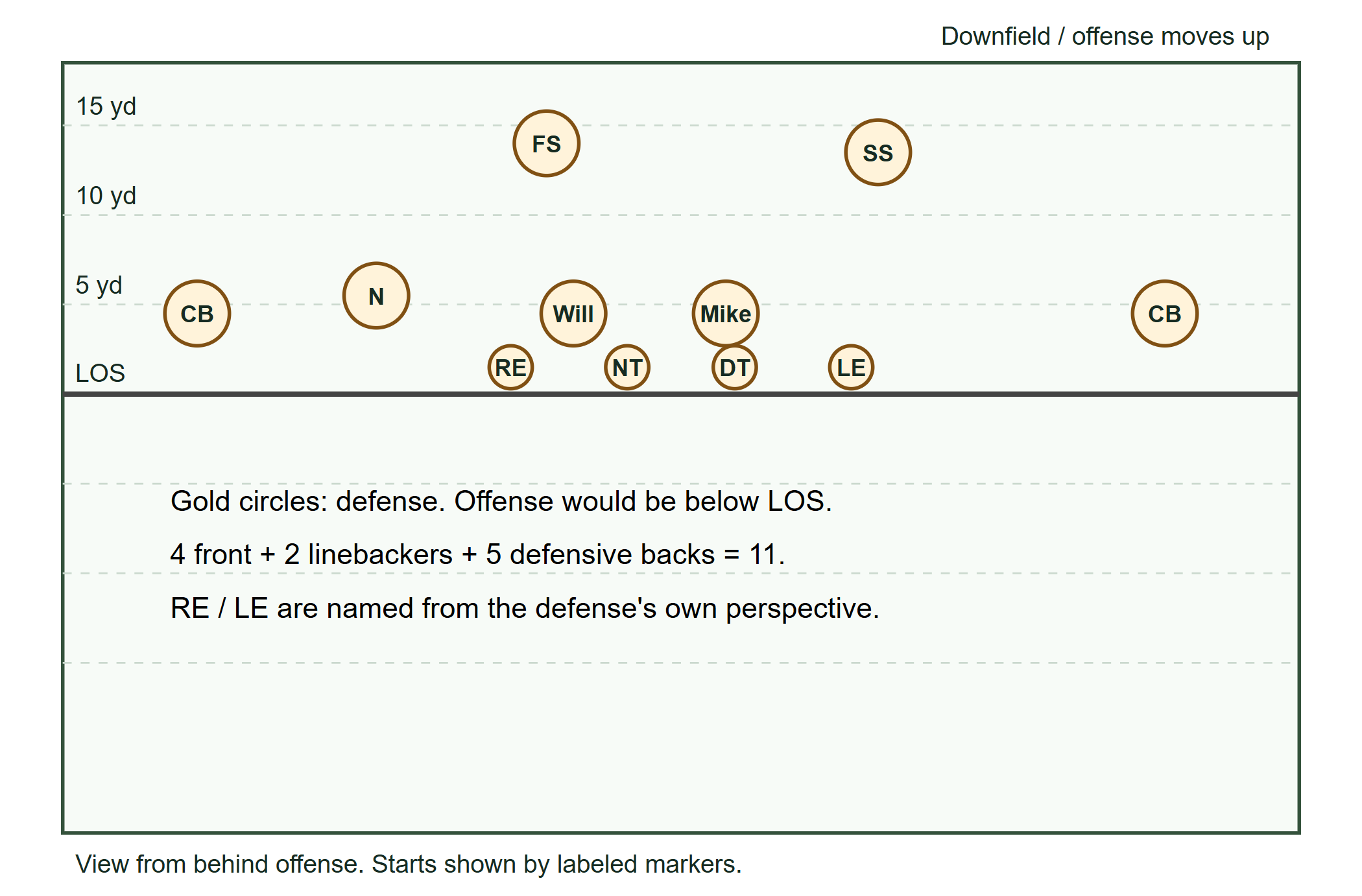
The 11 defensive positions in a 4-2-5
The defensive example has four linemen, two linebackers and five defensive backs. That is what 4-2-5 counts. The fifth defensive back is the nickel, often placed near a slot receiver. Mike and Will are linebacker labels; their exact duties depend on the call.
| Player | Start | Offense runs right | Offense passes |
|---|---|---|---|
| LE / RE: ends | Edges of the front | Play the assigned edge and pursue | Rush outside or execute a called exchange |
| DT / NT: defensive tackle and nose tackle | Inside the ends | Control assigned interior lanes | Push or penetrate the pocket |
| Mike / Will: linebackers | Behind the front | Read the blocking and fill assigned gaps | Drop into assigned zones in this example |
| Two CBs: cornerbacks | Outside, near X and Z | Handle outside support as assigned | Defend the outside receivers |
| N: nickel | Near W in the slot | Fit the run from the slot side | Cover the slot area or receiver |
| FS / SS: safeties | Deeper than the linebackers | Keep the run in front and support the fit | Protect assigned deep space |
These are two illustrative calls, not promises that every linebacker drops or every lineman rushes on a pass. A defense can blitz a linebacker, drop an end or rotate a safety toward the line. Watch the first few steps after the snap to confirm the assignment.
Find the positions on a broadcast
Find the ball and the center first. The guards are his immediate neighbors, and the tackles sit outside them. Then look between an outside receiver and the offensive tackle: an eligible receiver aligned in that space is in the slot. On defense, scan backward from the line to find the deepest players; those are usually the safeties in this example. Camera framing can hide them, so a close shot may not show the complete coverage.
Do not decide pass eligibility from a familiar position label alone. The NFL’s formation, numbering and reporting requirements determine eligibility. In the illustrated offense, X and Y are the ends of the seven-player line, while W, Z, QB and RB are behind it. For a forward pass thrown from behind the line, the ordinary backfield eligibility rule requires alignment at least one yard behind the line at the snap, alongside eligible numbering or reporting. See the 2026 NFL rules, Rules 5, 7 and 8.
What changes with formations and special teams?
A formation rearranges the players before the snap. Moving Y away from the tackle or moving W across the formation changes the picture without necessarily changing the personnel. Learn the jobs first, then ask how a particular alignment creates space or changes a blocking responsibility.
Special teams handle kicking plays, with jobs such as kicker, punter, long snapper, holder, returner and coverage player. Those units still operate with a full team of players, and many participants also have offensive or defensive roster positions. A player covering a punt is performing a special-teams assignment on that play.
For basic position vocabulary, the NFL’s football glossary is a useful companion. Use the official rulebook, rather than a role description, when the question is whether an alignment or action is legal.