
⏱ Estimated reading time: 4 min read
An offense can attack spot-zone Cover 3 by placing more route levels on one side than the nearby defenders can cover comfortably. A flood or sail concept does this with a vertical route, an intermediate outside route and a short flat route. The quarterback reads how the outside-third corner and curl-flat defender divide those threats, then throws only if a usable window develops.
This example is specific to four-underneath, three-deep spot Cover 3. A match call can carry the same routes differently. Calling a play a Cover 3 beater describes an intended stress, not a promised completion.
The starting picture and the three routes
The offense uses 11 personnel: five linemen, QB, RB, Y at tight end and three receivers, X, W and Z. X and attached Y join the five linemen on the line; W, Z, QB and RB are behind it. The board shows all 11 offensive starts, but only the two defenders central to this right-side read.
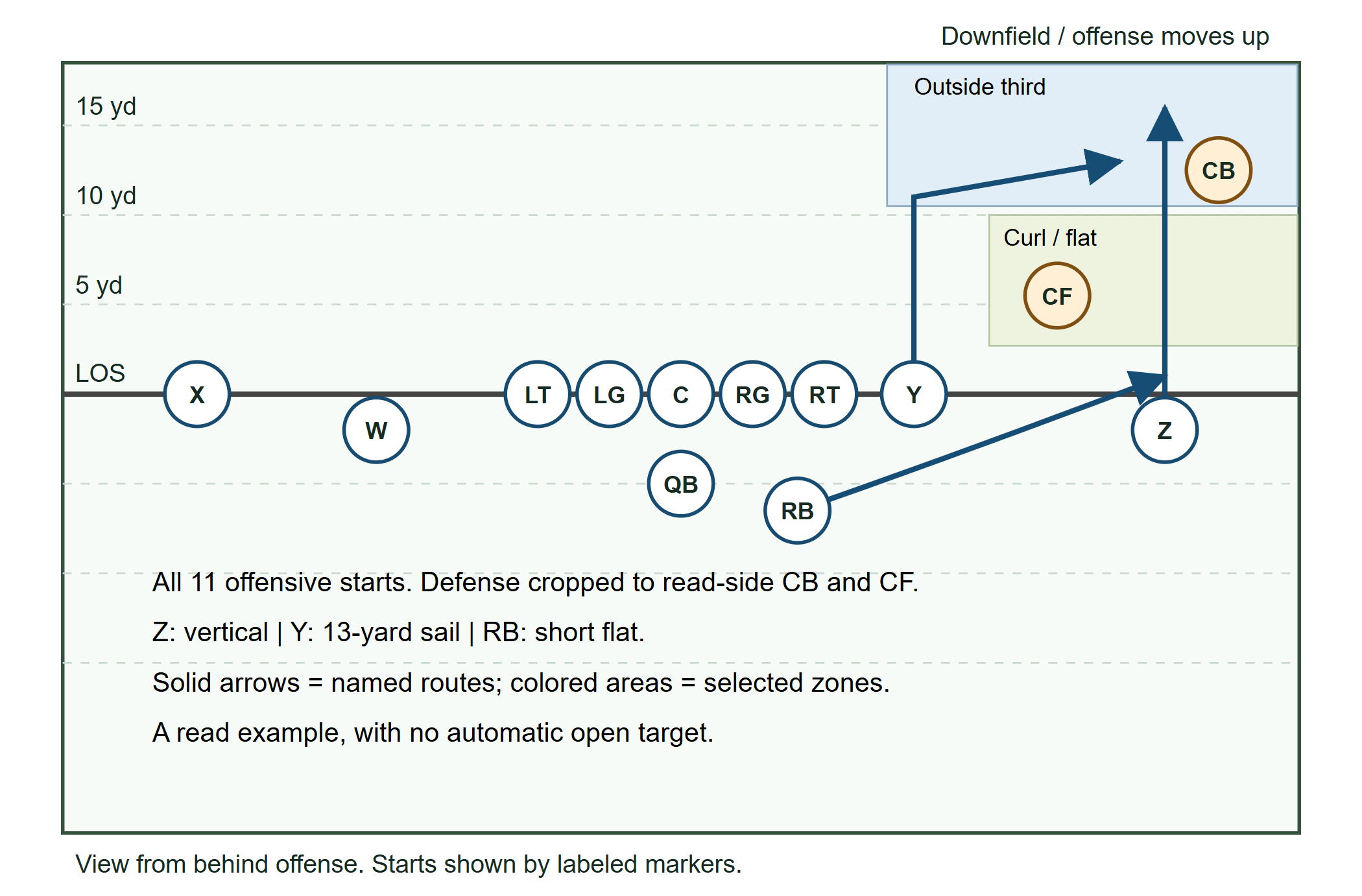
Z’s vertical route asks the corner to preserve his outside third. Y works at intermediate depth, beneath that deep responsibility but above the flat. RB offers the shortest outside target. If the corner respects Z, the curl-flat defender must decide how to relate to both Y and RB.
The other receivers and the protection remain part of the full call. Their details are not prescribed by these selected arrows. In particular, RB can release only when that is his assignment; a protection that needs him to block would change this version of the concept.
Read the conflict as the routes separate
QB begins confirming the coverage after the snap, while Y is still working into the stem. As the intermediate and short routes separate, he checks the corner’s depth and the curl-flat defender’s leverage. The intended decision point comes as the sail develops into its window, not after the receiver has stood outside waiting for the ball.
| Defensive response | Potential offensive answer | Condition that stops the throw |
|---|---|---|
| Corner stays deep with Z; curl-flat defender closes toward RB | Y’s sail above the short defender | The corner can overlap Y, or the underneath defender still has leverage beneath him. |
| Curl-flat defender widens and sinks beneath Y quickly | RB underneath, if safe | Another defender takes the flat or closes the throwing lane. |
| Corner does not leave enough intermediate space | Recheck the call’s other options | No sail window exists merely because Z ran vertically. |
| One defender expands beneath sail while another takes flat | Backside or outlet, if included in the design | Both frontside windows are squeezed; do not force either. |
A low defender can cover more space when the throw is late. That is why the picture must be read as it develops. The same routes can look open in a paused frame and become poor targets once the ball’s travel and the defenders’ movement are considered.
A defensive adjustment that defeats the simple read
Make the curl-flat defender expand under Y’s sail while a second underneath defender moves toward RB. The corner stays above the intermediate route as needed rather than disappearing from the play. Now Y has a defender below and deep support above, while RB is contested short.
QB’s answer in this model is to leave the frontside pair and use a backside route or outlet only if the play provides one and it is available. The diagram does not make that outlet automatic. Pressure can also end the useful decision window before another receiver becomes accessible.
Different stresses ask different questions
| Concept | Main stress | What changes from flood? |
|---|---|---|
| Flood / sail | Three levels toward one outside area | Read the outside-third and curl-flat relationship. |
| Middle dig | Intermediate space behind or between hook defenders | The inside underneath drops and middle safety matter more directly. |
| Four verticals | Multiple deep lanes across a three-deep structure | Track seam carries, spacing and safety responses; four routes do not automatically defeat three deep defenders. |
USA Football’s coverage overview supplies the basic flood, dig and vertical stress context. The Eagles’ 2018 Titans-game film discussion provides a documented example of attacking deep-and-underneath relationships. The Y-cross coaching explanation offers concept context, rather than proof of one universal NFL progression.
Keep the scope straight when watching: identify the actual spot-zone distribution first, follow the two defenders near the intended window, and confirm the throw. Route-matching rules may change who carries Y or RB, so the spot-zone read here cannot simply be copied onto every three-deep-looking defense.