
⏱ Estimated reading time: 4 min read
To attack Cover 2, an offense can place a short route and a deeper route in the space controlled by a flat corner and a deep-half safety. The aim is to make their responsibilities pull apart, then throw into the window their movement creates. The concept works only when the quarterback confirms that window; the coverage’s name does not make a pass available.
The examples here begin from a basic two-deep, five-underneath picture. They focus on offensive reads rather than identifying every defensive position. Both use the same 11-personnel offensive alignment, with seven players on the line and four behind.
The primary example: a short hitch and a high corner
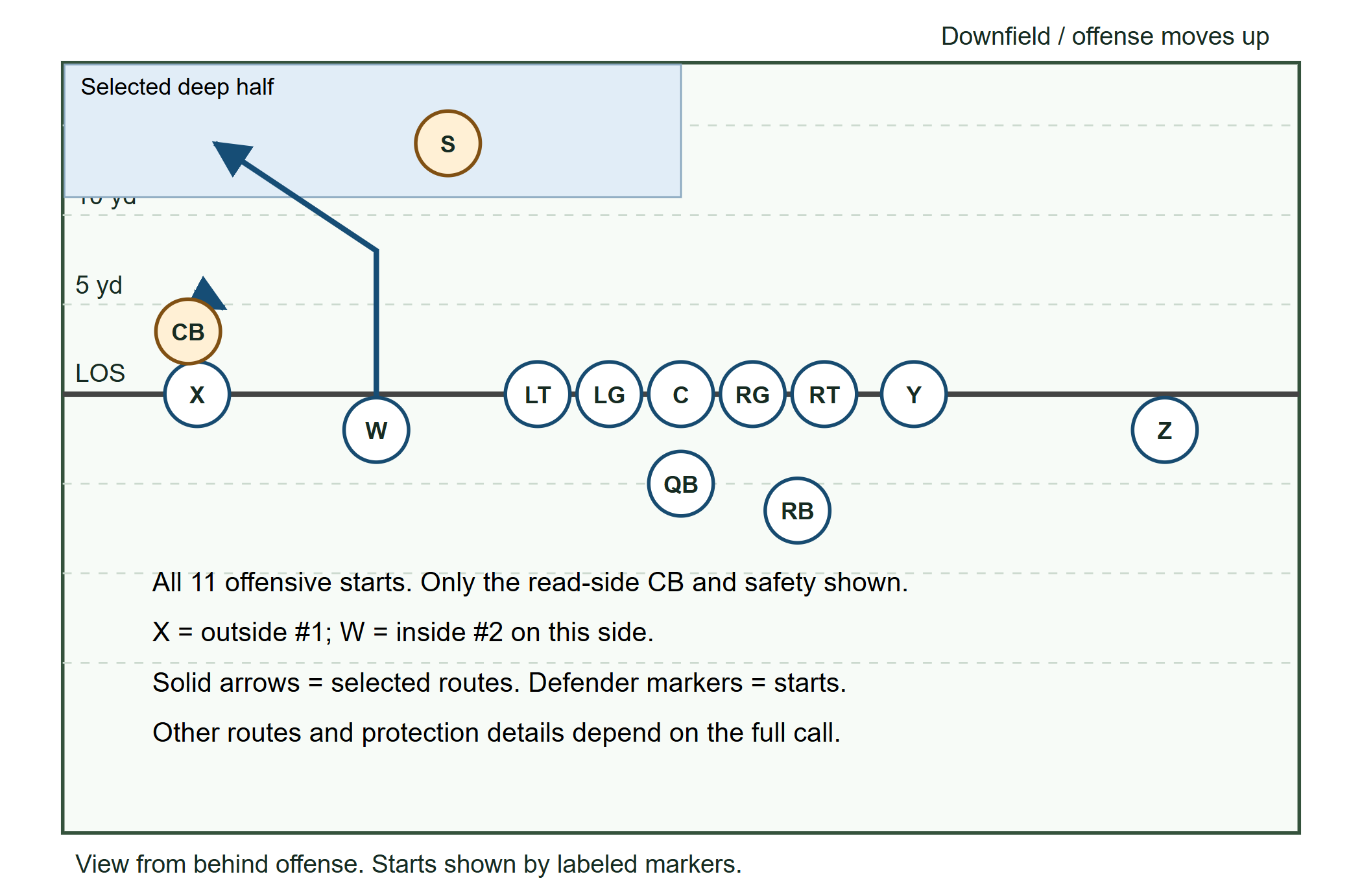
Count the formation before following the routes. LT, LG, C, RG, RT, X and Y are on the line. QB, RB, W and Z are behind it. X and Y are the ends, and the example assumes normally eligible numbering and the applicable eligibility requirements. The board is a teaching alignment, not a ruling on an unidentified real lineup.
The outside hitch offers a short target. The inside corner route works above and outside that target. QB reads the relationship between the flat corner and the half safety, rather than assuming that one defender’s first step answers the whole question.
- If CB drives the hitch: check whether the half safety can reach the corner lane. A high window may exist when CB is low and the safety cannot overlap it.
- If CB sinks beneath the corner: check the hitch’s cushion. The short pass may be available, but only if the corner or another underneath defender cannot close it immediately.
- If both windows are squeezed: continue the called progression or make the play’s other allowed decision. Do not force either route merely to complete the concept.
The safety is part of every branch. A corner moving forward is not permission to throw over him if the safety is already on top of the corner route. A receiver turning outside can also arrive too close to the sideline or too late for the protection; route spacing and timing remain part of the decision.
A separate alternate: vertical outside, flat inside
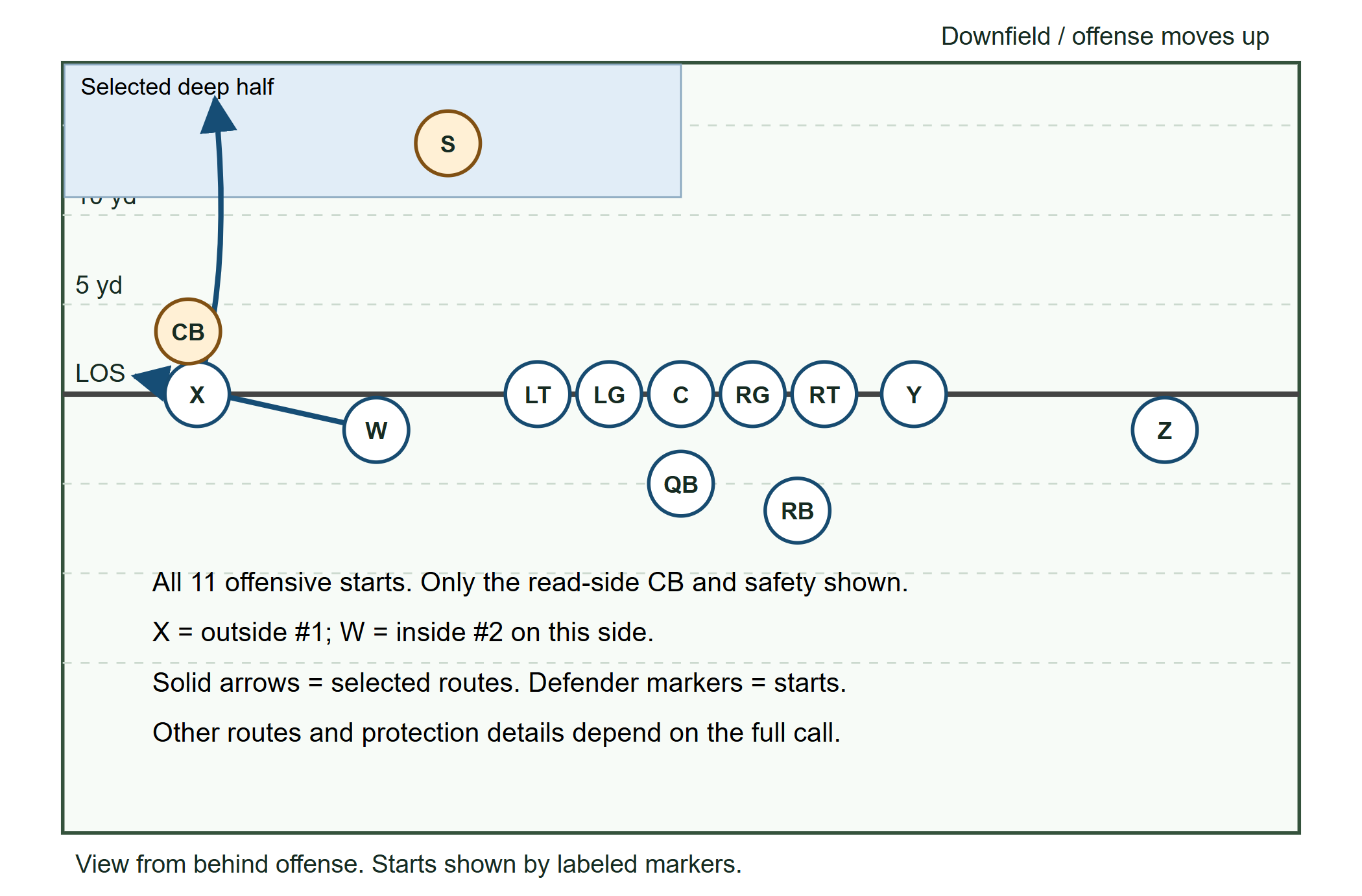
Here QB checks whether the corner remains involved with X’s vertical release or closes toward W. The vertical throw requires space beyond or outside the corner and below the safety’s effective overlap. The flat throw requires an accessible short window. If the corner stays connected to X while another defender contests W, the two routes may both be covered.
| Concept and trigger | Window to confirm | Abort condition |
|---|---|---|
| Hitch/corner: CB drives the hitch | Corner lane above CB and beyond the safety’s reach | Safety overlaps the lane or the receiver has no usable outside space. |
| Hitch/corner: CB sinks | Hitch with enough cushion for the throw | CB can drive it or another defender is already contesting it. |
| Vertical/flat: CB closes low | Vertical lane that the half safety cannot erase | Safety remains above the receiver with suitable leverage. |
| Either concept: defense distributes both routes | No assumed window | Both targets are squeezed; follow the rest of the called progression. |
The counterexample: the defense changes the read
Cover 2 Read or a match-based adjustment can prevent the simple “corner low, throw high” picture from developing. In a reproducible version of that counter, CB stays connected to outside #1 while the safety handles the developing high route and another underneath defender contests the short space. In another version, CB sinks into the corner lane while help narrows the hitch. The quarterback sees neither target cleanly.
Those outcomes explain why these are stress concepts, not guaranteed beaters. The defense’s actual rules determine who carries each route. A pre-snap two-high shell cannot establish that the corner will behave like the basic flat defender in the first example.
USA Football’s coverage overview supplies the basic Cover 2 and smash context. Adam Harvey’s Cover 2 Read account shows why smash and fade-flat must be evaluated against the defenders’ rules. Its coaching case is not a universal NFL prescription. The progression-passing explanation supports the larger point: a read belongs within an ordered play, with another decision available when the intended window closes.