⏱ Estimated reading time: 4 min read
Pass protection is the coordinated assignment of blockers to the defense’s rush threats. Its purpose is to give the quarterback usable time and space to throw. You understand it by asking who owns each threat or area, then checking how those responsibilities change when defenders move.
A protection can fail even when the offense appears to have enough bodies. Six blockers do not automatically account for six rushers if several blockers are assigned to one side while another side receives an extra threat. The six-man half-slide example below makes that distinction visible.
Three ways to distribute responsibility
| Family | Basic organizing idea | Question to ask |
|---|---|---|
| Full slide | The line works through coordinated area or gap responsibilities in one direction | Who handles the edge or threat beyond that slide? |
| Man-based rules | Blockers identify particular defenders, with the call defining adjustments | How are exchanges and added rushers communicated? |
| Half-slide | One part uses area rules while the other locks identified defenders | Which threats belong to the back? |
Teams can teach these families differently. “Slide left” is not enough information by itself to assign every defender. You also need the front identification, the back’s rule and any adjustment or quick-throw answer built into the play.
The worked example: half-slide left, RB scans right
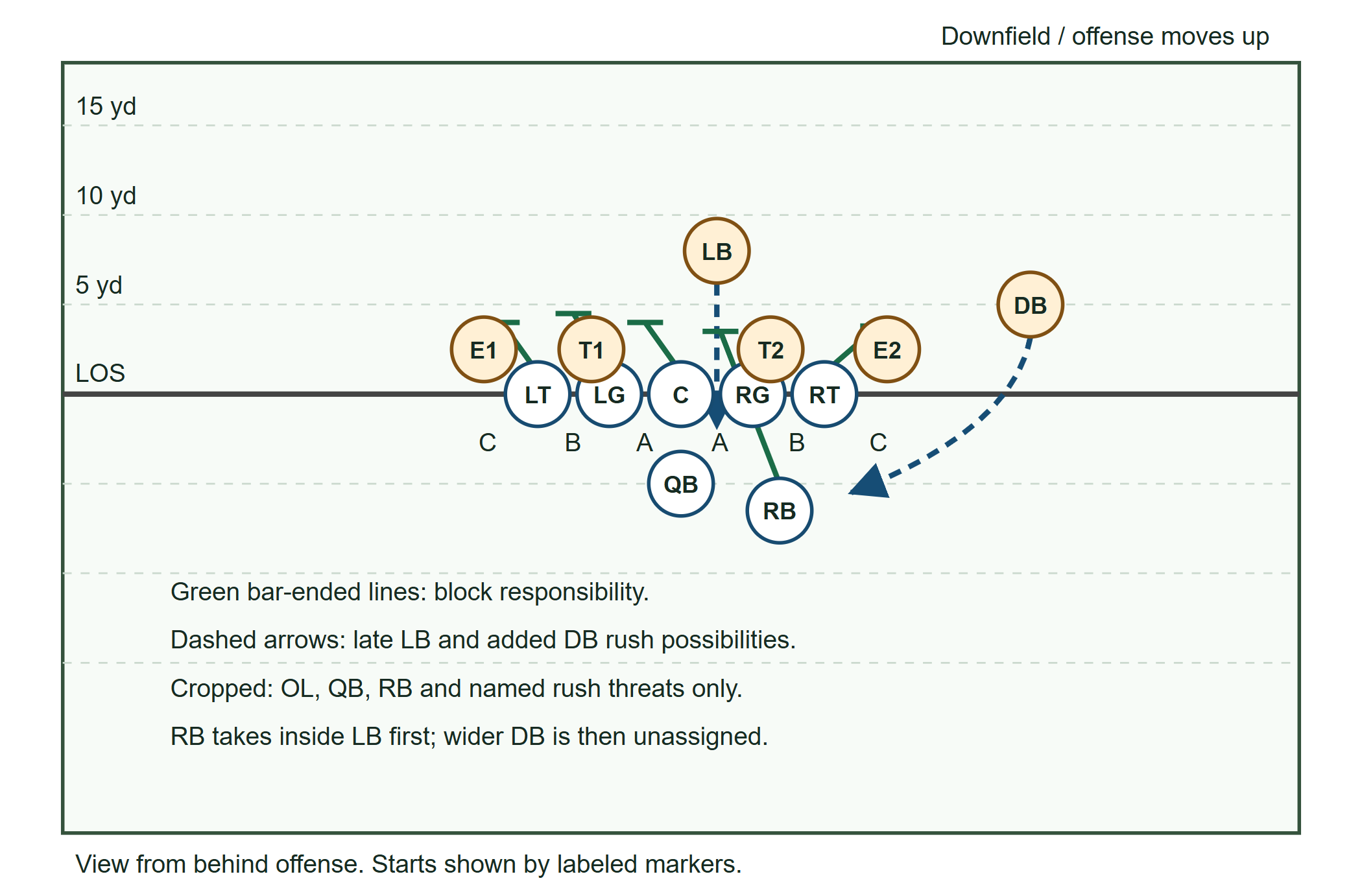
The offense faces upfield. The five linemen are LT, LG, C, RG and RT; QB is in shotgun, with RB offset. Four defenders are initially near the front: E1 and T1 to the offense’s left, T2 and E2 to its right. LB is a possible late right-interior threat. DB is a separate, wider overload possibility.
The diagram is cropped to those seven offensive positions and the named defenders. It does not attempt to show a full 11-player formation or the routes of the other eligible receivers.
| Blocker | Responsibility in this call | How to read it |
|---|---|---|
| LT | Left C / edge area | Handle the threat entering that outside area. |
| LG | Left B area | Work the adjacent area with LT and C. |
| C | Left A area, after the snap | Protect the interior of the slide side. |
| RG | Identified right defensive tackle, T2 | Remain responsible for that locked defender under the call. |
| RT | Identified right edge, E2 | Account for the right outside rusher. |
| RB | Right A first, scanning inside-out | Take the late LB if he rushes; move wider only when the inside rule permits. |
A stunt changes the path, not the area count
Now let the two left-front rushers swap adjacent lanes. E1 penetrates from left C into B and LG takes him. T1 loops from B into C and LT takes him. C still owns left A and can respond if another defender enters that gap. Under these area rules, the blockers do not have to chase the original jersey across a teammate’s lane.
That exchange still requires recognition and execution. Calling it an area protection explains the intended handoff; it does not prove that a blocker made the handoff successfully on a real snap. A viewer should track where each rusher finishes, not only where he lined up.
The overload: one back, two added threats
With only LB added on the right, RB’s scan gives him that inside threat. Add the wider DB at the same time and the problem changes. RG already has T2, RT already has E2, and RB takes LB under the declared inside-out rule. DB is unassigned. An apparently spare blocker on the left is not automatically available to cross the pocket and solve it.
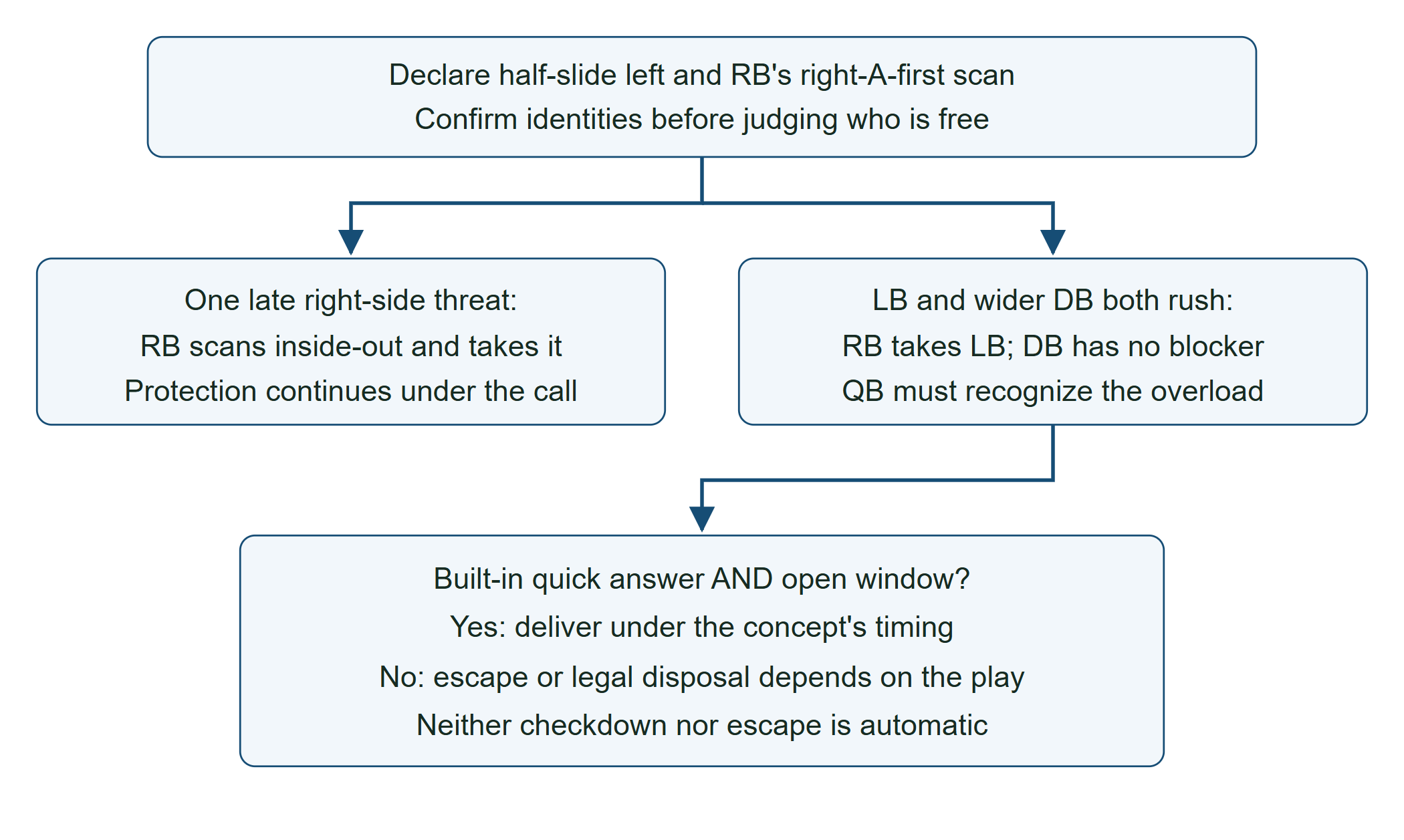
A built-in hot or quick answer can give QB a way to release the ball before the free rusher arrives, but only if the play contains that answer and the coverage permits the throw. Sending the ball to a checkdown is not automatic: RB is blocking LB in this example. Escaping also depends on the space available. Any disposal of the ball must meet the legal-pass and grounding requirements.
For the teaching framework, see USA Football’s gap-responsibility and pass-protection explanation and progression-passing discussion. For the limits on a quarterback’s legal forward pass or disposal, consult Rule 8 of the 2026 NFL rulebook. The board is an original assignment model, not a tested protection or a claim about a particular NFL team’s terminology.