

⏱ Estimated reading time: 4 min read
The NFL salary cap limits a team’s counted salary charges for a league year. It is not a simple total of cash paid during that year. A signing bonus can be paid at one time while its cap cost is allocated across several contract years. That difference explains how releasing a player can save cash yet leave the team with a larger current cap charge after replacing him.
The 2026 base league cap is $301.2 million. A club’s adjusted cap can differ. To make the arithmetic reproducible, this model uses exactly $301.2 million, with no carryover or other adjustments. Every contract and roster amount below is hypothetical.
Fix the assumptions before adding the numbers
| Input | Assumption |
|---|---|
| Model year | 2026, Year 2 of a three-year 2025-27 contract |
| Cap limit | $301.2 million; no carryover or other cap adjustments |
| Signing bonus | $6 million paid in Year 1, allocated $2 million per year over three years |
| Base salaries | $2 million in 2025, $3 million in 2026, $4 million in 2027 |
| Other compensation | No other bonuses or guarantees |
| Release branch | Before June 1 in Year 2; ordinary acceleration, with no acceleration exception or special designation |
| Replacement | $1.2 million in both cash and cap charge for 2026 |
| Other counted team charges | $295.5 million, unchanged in both branches and excluding this player and his replacement |
These assumptions matter as much as the dollar figures. Adding a guarantee or changing the release timing could change the result. The model excludes those complications so you can reproduce each step.
One contract, two different timelines
Divide the $6 million signing bonus by the three contract years: $6 million / 3 = $2 million per year. If the player stays for the whole deal, each year’s cap charge is that year’s base salary plus the $2 million allocation. Cash follows when the payment is made instead.
| Year | Base cash | Signing-bonus cash | Total cash | Bonus cap allocation | Total cap charge |
|---|---|---|---|---|---|
| 2025: Y1 | 2 | 6 | 8 | 2 | 4 |
| 2026: Y2 | 3 | 0 | 3 | 2 | 5 |
| 2027: Y3 | 4 | 0 | 4 | 2 | 6 |
| Total | 9 | 6 | 15 | 6 | 15 |
The totals agree over the full deal: $15 million of cash and $15 million of cap charges. The annual numbers differ. In 2025 the team pays $8 million but counts $4 million. In 2026 it pays $3 million but counts $5 million. That timing difference is the point of separating the columns.
Release before June 1 in Year 2
At the start of the 2026 release branch, $2 million of the bonus has already counted in 2025. The remaining unamortized amount is $6 million – $2 million = $4 million. Under the assumed ordinary pre-June 1 acceleration, that $4 million counts now.
The player receives no new 2026 cash in this branch because the model includes no remaining guarantee or other payment obligation. The accelerated charge represents bonus money already paid in 2025. It is dead money on the cap, not a new $4 million check to the released player.
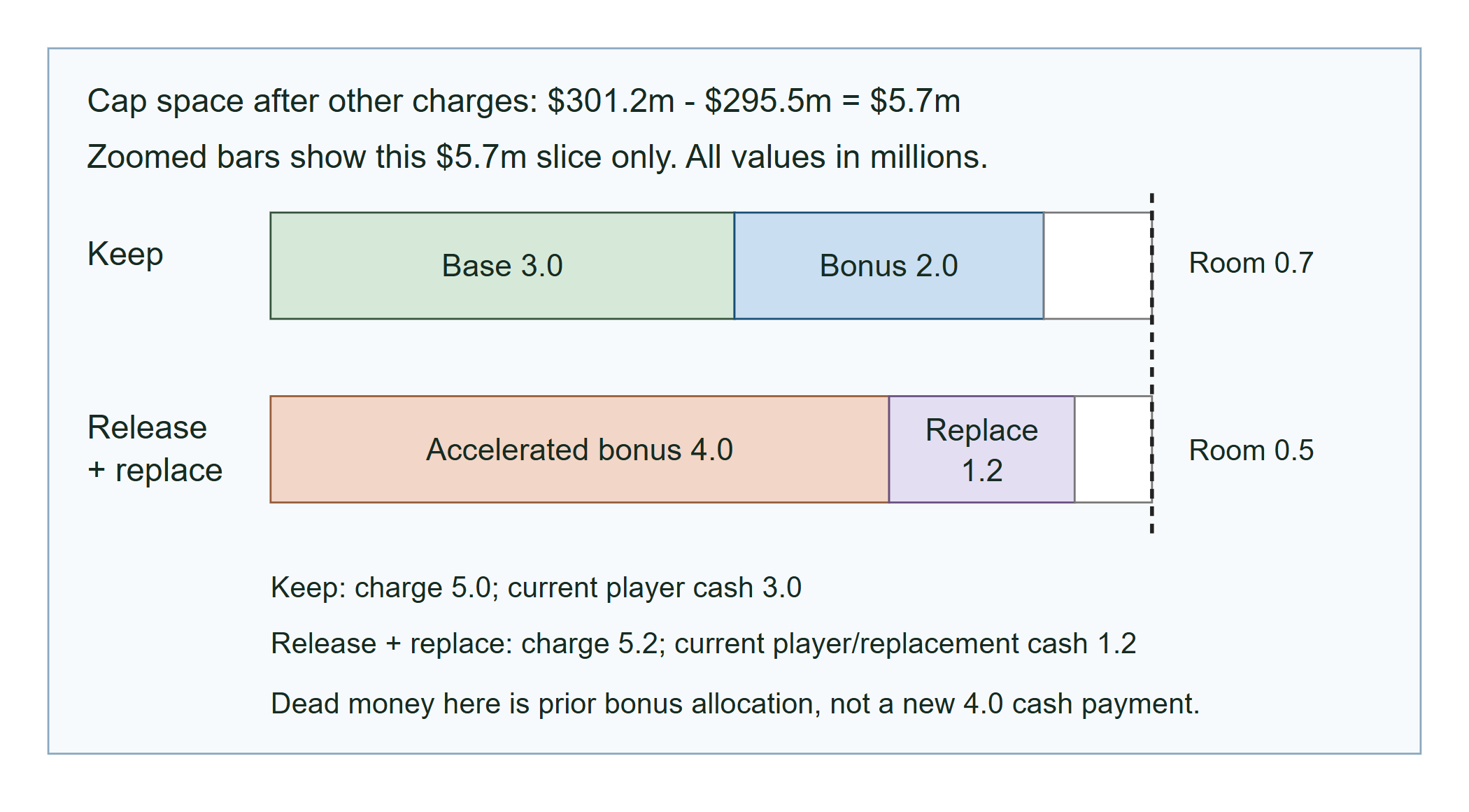
Now add the replacement’s $1.2 million. Releasing and replacing costs $4 million + $1.2 million = $5.2 million in 2026 cap charges. Keeping the original player costs $5 million. The cheaper current cash decision is therefore $0.2 million more expensive against this year’s cap in this particular model.
Check the entire counted roster total
| Calculation | Keep | Release before June 1 and replace |
|---|---|---|
| Original player charge | 3 base + 2 bonus = 5 | 4 accelerated bonus |
| Replacement charge | 0 | 1.2 |
| Decision’s cap cost | 5 | 5.2 |
| Other counted charges | 295.5 | 295.5 |
| Team total | 295.5 + 5 = 300.5 | 295.5 + 5.2 = 300.7 |
| Room under 301.2 | 301.2 – 300.5 = 0.7 | 301.2 – 300.7 = 0.5 |
| Current cash for these player choices | 3 | 0 to released player + 1.2 to replacement = 1.2 |
The release-and-replace branch saves $1.8 million in current cash compared with keeping the player, while reducing current cap room by $0.2 million. Neither number says whether the replacement is a good football choice. They answer different accounting questions.
Why the timing boundary belongs in the answer
A post-June 1 treatment can change when remaining bonus charges count, subject to the applicable provisions and any designation rules. The remaining unamortized bonus still affects the cap. The rule determines when those charges count. It is outside the calculation above; the $4 million immediate acceleration depends on the stated pre-June 1 assumptions.
The official 2026 NFL free-agency questions and answers supplies the base cap figure. CBA Article 13, Sections 4-6 governs the relevant team-salary timing, bonus and acceleration mechanics, while Article 12 covers adjustments. The NFL’s contract-language explanation provides the signing-bonus context. The model illustrates those mechanisms without claiming to describe an actual player’s contract.