
⏱ Estimated reading time: 4 min read
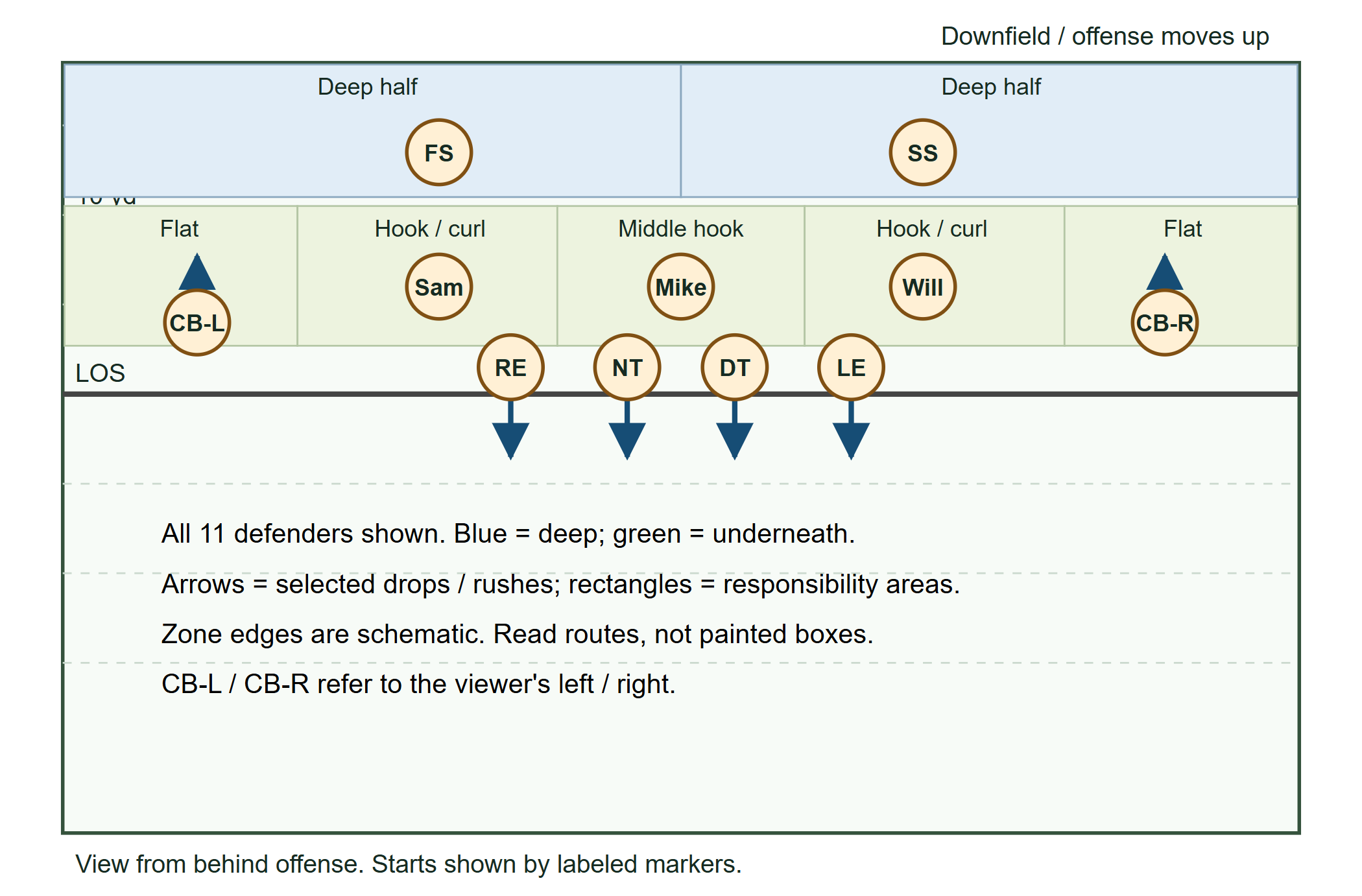
Cover 2 divides the deep field between two safeties. In the basic zone model here, five defenders work underneath and four rush the passer. Its central bargain is clear: keep help over both sides while the underneath defenders control short throws and connect those deep halves to the line.
Read this coverage through the defenders’ decisions. A corner does more than stand in a flat, and a safety does more than retreat into a colored box. Both have to respond to routes while preserving their relationship. The diagrams retain the shared view from behind the offense, with downfield up; the explanations focus on defensive responsibility.
The full 11-player model
| Defender | Job | What changes the decision? |
|---|---|---|
| FS and SS | One deep half each | Route distribution and threats entering the half; preserve depth while helping outside. |
| CB-L and CB-R | Left and right flats | Receiver release, an immediate flat threat and whether the throw is declared short. |
| Sam and Will | Hook-curl areas on either side of Mike | Inside releases and routes entering or leaving those areas. |
| Mike | Middle hook | Threats through the middle, while staying within this call’s underneath role. |
| RE and LE | Edge rush assignments | Protection and the passer’s location; the call sets the rush lanes. |
| NT and DT | Interior rush assignments | Interior blocking and the called rush relationship. |
That accounts for two safeties, two corners, three linebackers and four linemen: 11. A particular defense can use different personnel or adjust its drops, but those changes should be identified rather than silently inserted into this model.
The flat corner has a read, not an automatic charge
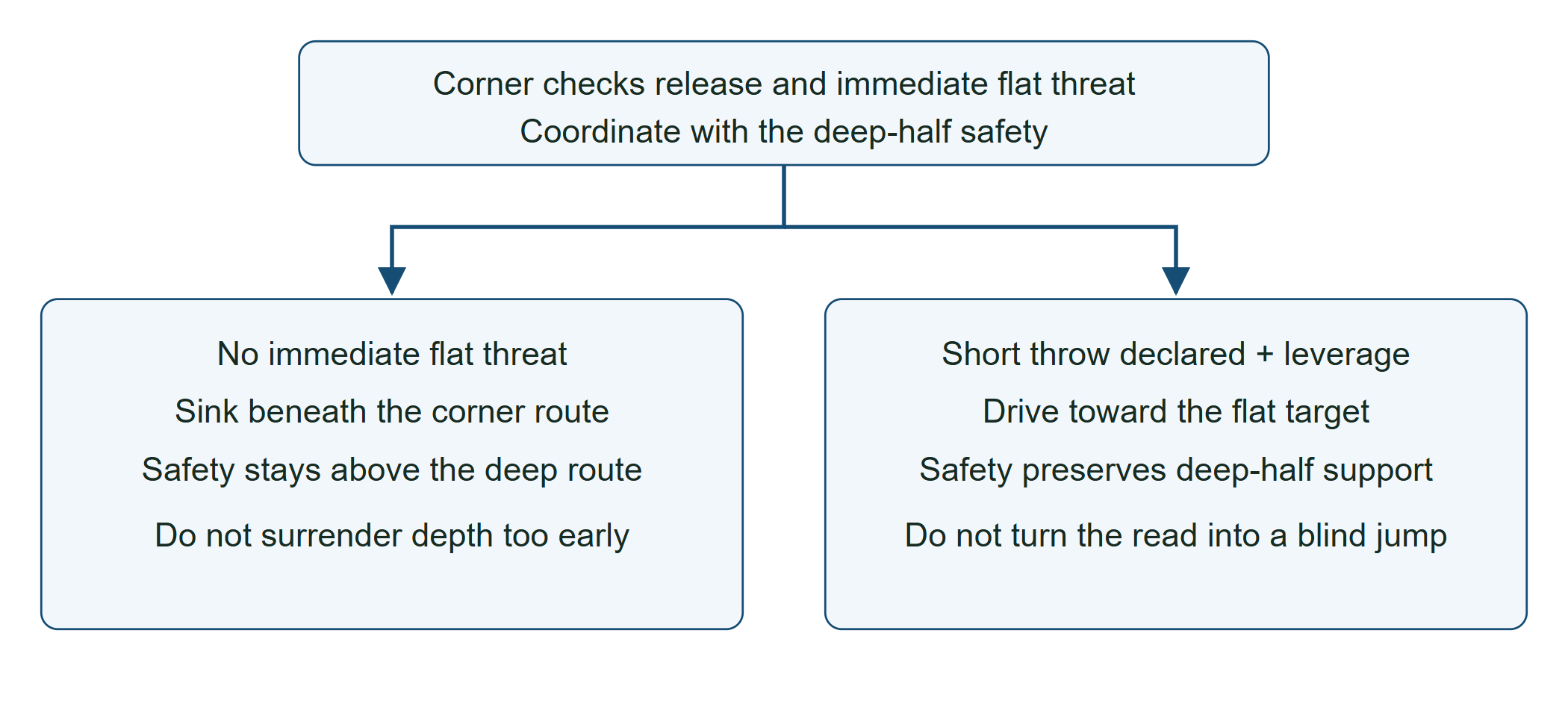
Reaction one: no immediate flat threat. Suppose a receiver pushes upfield and breaks toward the deep outside, with no receiver immediately entering the flat. The corner can sink beneath that corner route while the half safety stays above it. Their spacing narrows the available throwing window. The corner is still part of underneath coverage; he has not become a third deep safety.
Reaction two: a short throw is declared. If the ball is thrown to the flat and the corner has the leverage to drive, he closes toward the target. The safety must maintain the deep-half relationship rather than following the corner down toward the same short receiver. This requires communication and route recognition, not merely fast pursuit.
One failure: the corner goes too soon
Imagine the corner driving toward a short receiver before the throw is declared. A deeper outside route continues behind him. If the half safety is still too far inside to overlap that space, the defense has opened a window between the flat defender and the deep half.
The problem is the relationship between defenders: the corner has surrendered depth before the safety can support it. Calling the play Cover 2 does not remove that window. Conversely, a corner who sinks appropriately and a safety who maintains the right depth can make that same throwing lane much less attractive.
The deep middle is another area to watch in this particular model. Mike is a middle-hook defender, not a full-time deep-middle runner. A route developing above his drop and between the safeties can stress the coverage. That observation describes the coverage’s structure; detailed offensive combinations belong to a separate concept discussion.
Two high is a clue; the post-snap jobs confirm it
Two deep safeties before the snap suggest a two-high shell. They do not prove the final coverage. A safety can rotate after the snap, and different coverages can begin from similar looks. Confirm who takes the deep areas and how the corners and linebackers respond to the routes.
Tampa 2 adds a middle-runner role to the family: the middle defender carries deeper through the center rather than remaining only in the hook area shown here. Do not give the illustrated Mike both jobs without changing the model. Cover 2 Read is also a role-based variation, not a synonym for every basic Cover 2 call.
USA Football’s basic coverage explanation by Anthony Stone supplies the foundational picture. Adam Harvey’s Cover 2 Read account describes a specific coaching approach and should be read as that variation. These are teaching frameworks, not an assertion that every NFL defense uses identical calls.
On the next snap, locate the two safeties, then follow one corner and the safety above him. Watching that pair gives you a manageable way to see whether the underneath and deep coverage remain connected.