
⏱ Estimated reading time: 5 min read
Offensive schemes differ in how they create space, connect runs to passes and organize the quarterback’s decisions. A useful comparison starts with those principles, rather than a list of team names. Timing passes, spread dropback concepts and wide-zone play-action can all appear in one offense.
The models below keep the same 11 personnel and starting picture: five linemen, QB, RB, Y at tight end, and X, W and Z at receiver. Holding that picture steady makes the change in logic easier to see. These are concept families, not branded playbooks or mutually exclusive categories.
Compare the principles on the same terms
| Criterion | Timing / progression short pass | Spread / dropback spacing | Wide-zone / play-action |
|---|---|---|---|
| Tempo | Can vary; a quick throw does not require hurry-up operation | Can vary; spread spacing does not set the snap pace | Can vary; run action does not dictate huddle speed |
| Spacing | Short routes separate defined windows | Width and layered depths stretch coverage | Run flow invites defenders forward or sideways; routes work behind them |
| Run/pass logic | Use a pass to solve a specific coverage problem on schedule | Use complementary routes to stress a defender or progression | Make the pass resemble an established run action |
| QB decision | Follow the defined read and outlet | Read the called crossing or high-low relationship | Carry out the fake, then locate the intermediate window |
| Protection | Must support the timing and account for pressure | Must support the called drop and route development | Must sell action while preserving the passer’s space |
| Strength | Can deliver a clear, timely answer | Can create room at multiple depths | Can put second-level defenders in conflicting roles |
| Tradeoff | A defender taking the first window forces the next decision | Developing routes need time and coordinated spacing | A defender who does not react to the run action can remain in the window |
1. Timing and progression: out, flat and outlet
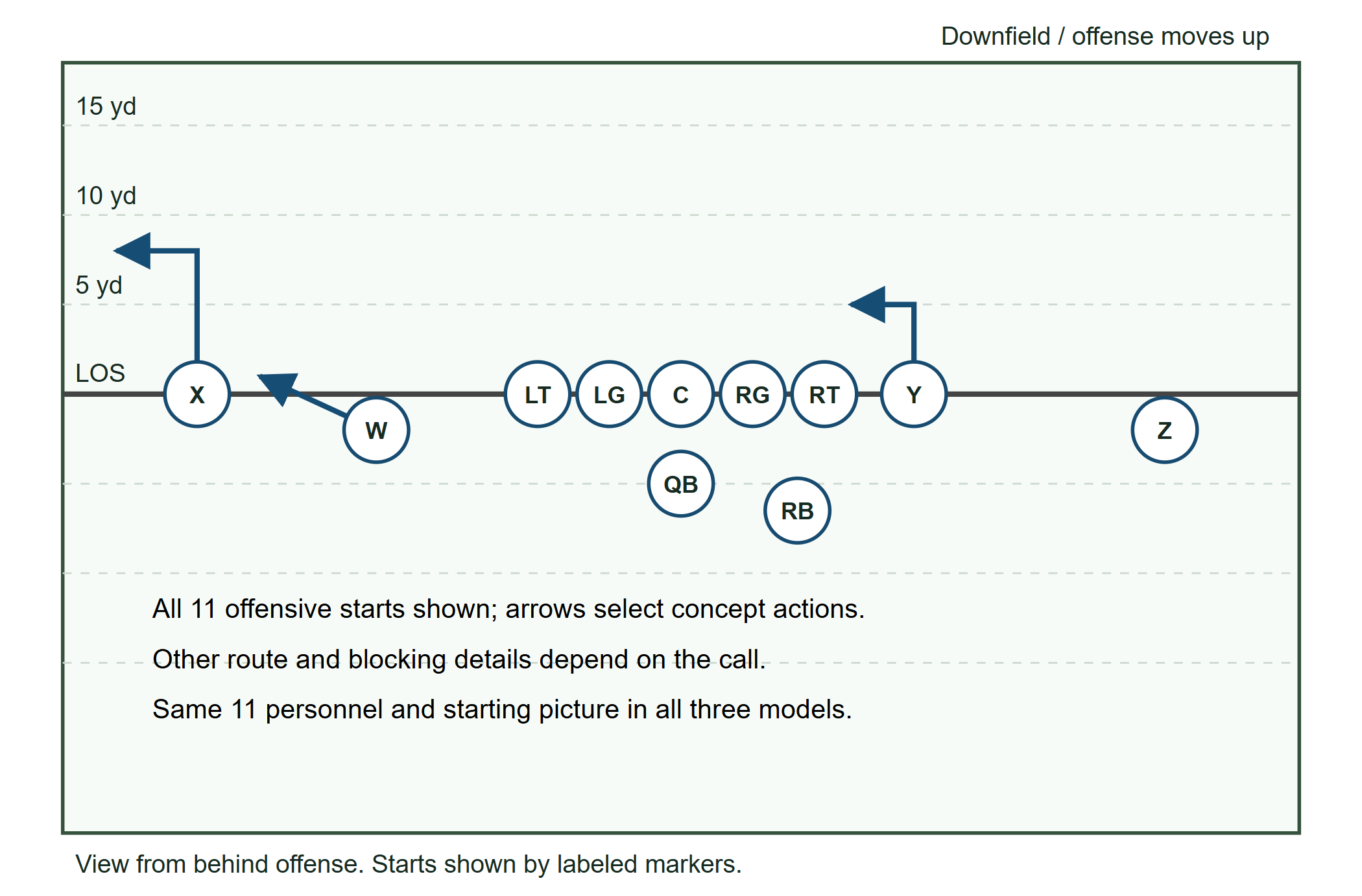
The quarterback is not simply told to “throw short.” The call gives him a sequence and an intended delivery rhythm. In this illustration he checks the out/flat relationship, then uses the called outlet if the defense takes away the first window. The outlet is a planned option, not a promise of an open receiver.
Watch whether the ball arrives as the receiver becomes available. A late throw can allow a defender to close a window that existed briefly. The USA Football progression-passing explanation supplies coaching context for organizing reads; the model here is our own simplified example.
2. Dropback spacing: Y cross and a high-low
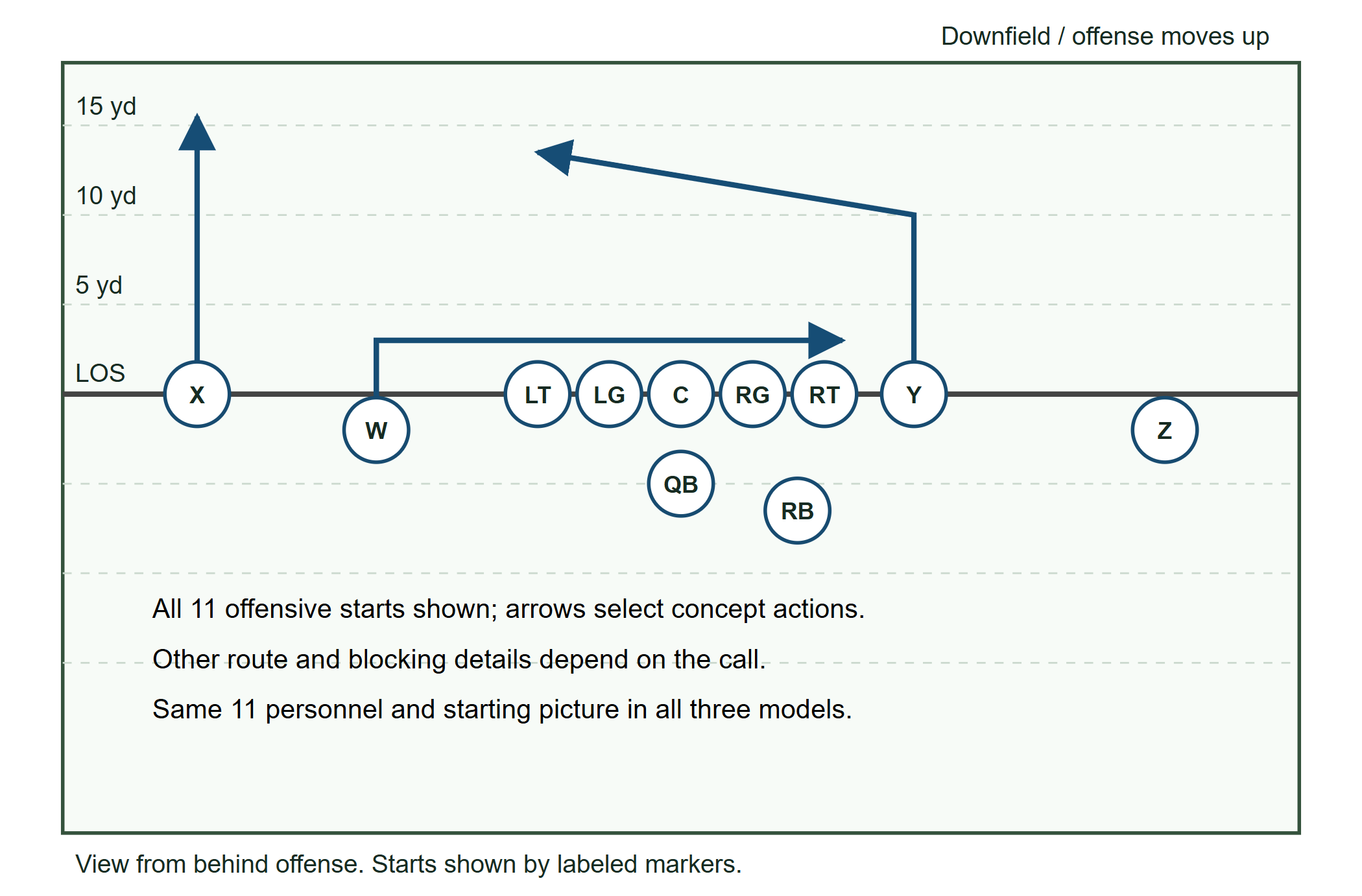
This family creates a problem by putting targets in different spaces. A defender moving toward the shallow route can leave room behind him; a defender gaining depth can leave the lower target available. The quarterback must still read the actual coverage and follow the call’s progression.
USA Football’s Josh Herring Y-cross breakdown is a documented coaching example of route and read design. It is useful for understanding the concept, but it is not evidence that an NFL team runs that exact teaching progression or uses the same terminology.
3. Wide-zone play-action: show flow, throw behind it
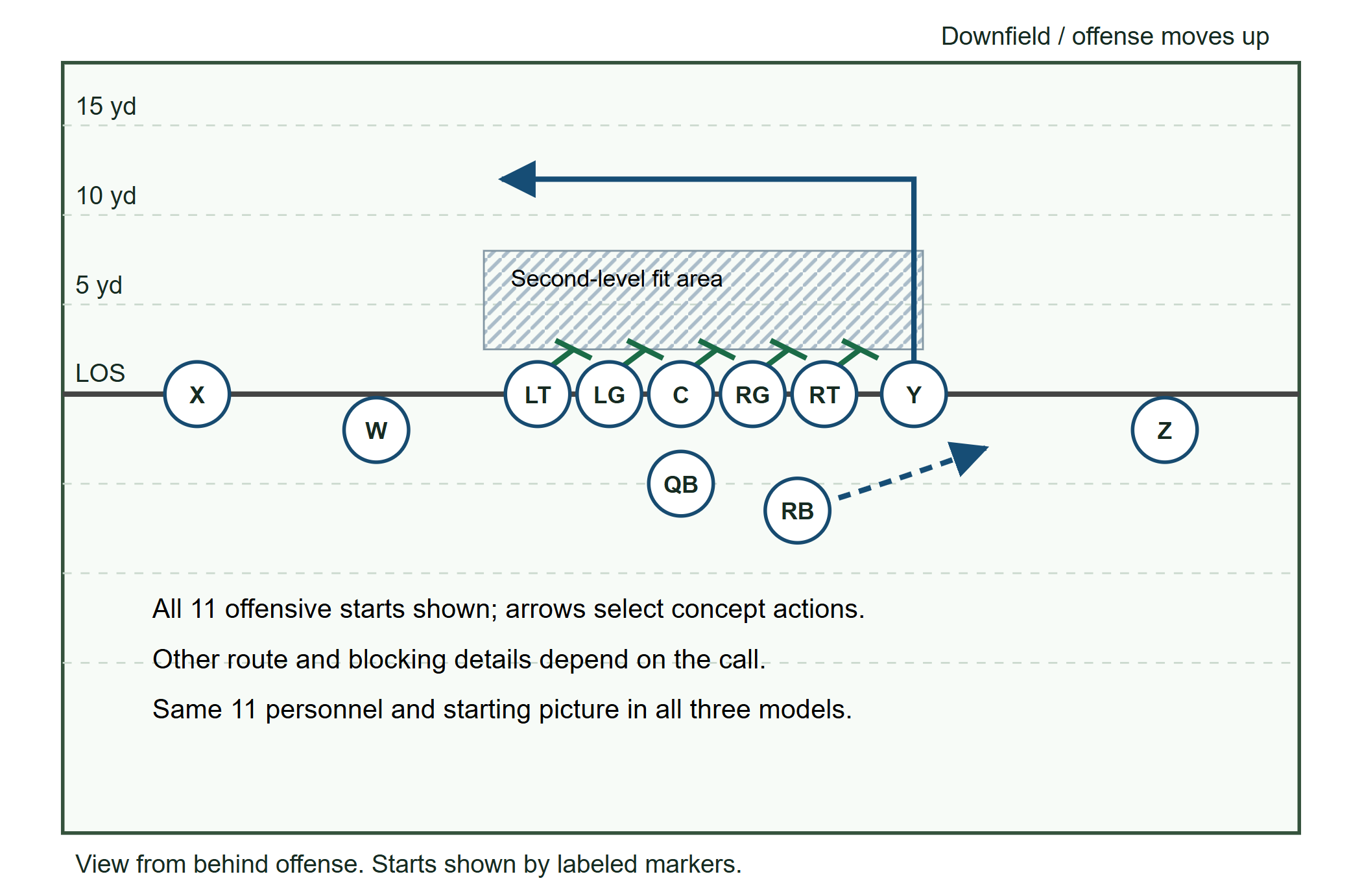
The offense first presents information that resembles a run. A linebacker responsible for fitting that run has to decide whether to move toward it or gain depth into coverage. A pass route behind that decision can create useful space. The action works through the relationship between blocking presentation, the back’s track and the route; a fake by itself does not guarantee a defender will leave.
One documented NFL example comes from Tennessee against Philadelphia in 2018. The Eagles’ film column on that game describes Matt LaFleur’s tight receiver splits and play-action creating second-level conflict against a Cover 3 picture. That episode supports the principle. It does not establish the Titans’ present system, every defender’s assignment or a universal result against Cover 3.
Where RPOs fit, and where the labels stop
A run-pass option adds a run/pass decision within a system. It is not a complete offensive identity by itself. USA Football’s power Houston option example from Liberty High School is a specific coaching case, not proof of an NFL team’s playbook.
When watching an offense, ask what conflict the play creates, what information the quarterback uses and how the protection supports that decision. Then compare the next play. A formation tells you where the players begin; a concept explains a particular coordinated solution; a system organizes the collection. Those distinctions make the labels useful without forcing an offense into one permanent box.