

⏱ Estimated reading time: 5 min read
Under the 2026 NFL overtime rules, both teams can have an opening opportunity to possess the ball, but the regular-season clock limits that promise. A regular-season game has one 10-minute overtime period and can end tied. A postseason game uses 15-minute periods as needed and continues until there is a winner.
An opening touchdown does not automatically end every overtime game. Follow the possession sequence, the score and the remaining time together. The trees below use A for the initial receiving team and B for its opponent; they describe the 2026 version of Rule 16, not rules remembered from an earlier season.
Regular season: the 10-minute limit matters
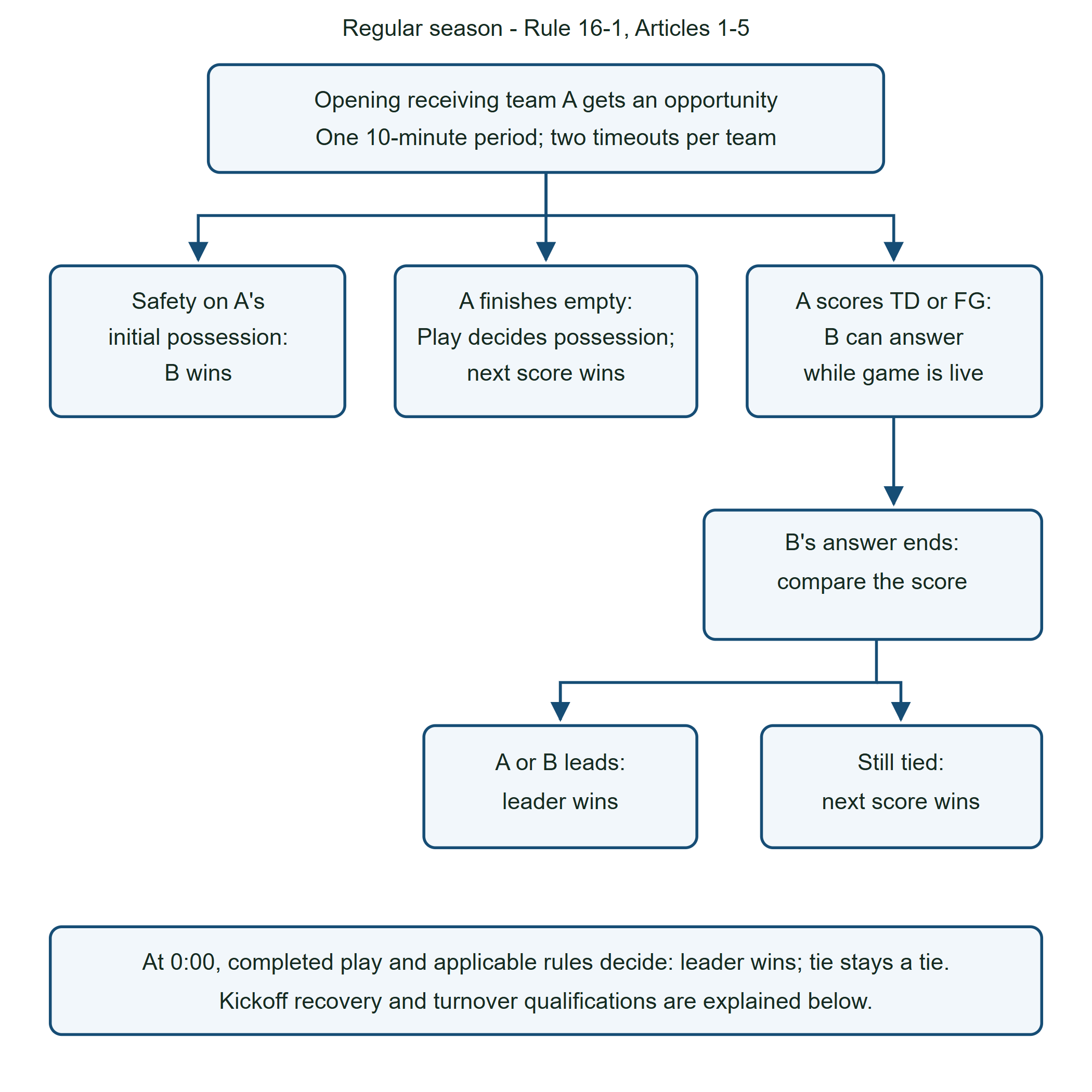
If A’s opening opportunity ends without a score, the game moves to next-score-wins. B can win with a field goal or touchdown if it gets the ball. A may instead keep the next series after recovering a muffed punt that counted as B’s opportunity (Art. 5(c), A.R. 16.5). A safety on the initial receiving possession is a specific exception to the usual opening exchange: B wins.
If A opens with a field goal or touchdown, B can answer while time remains. B must do enough to tie or take the lead. After both opening opportunities, a tie sends the game to next-score-wins; an unequal score produces a winner under the possession rules. The game does not acquire a second 10-minute period simply because B has not finished its chance.
Postseason: a period can end before the opportunity does
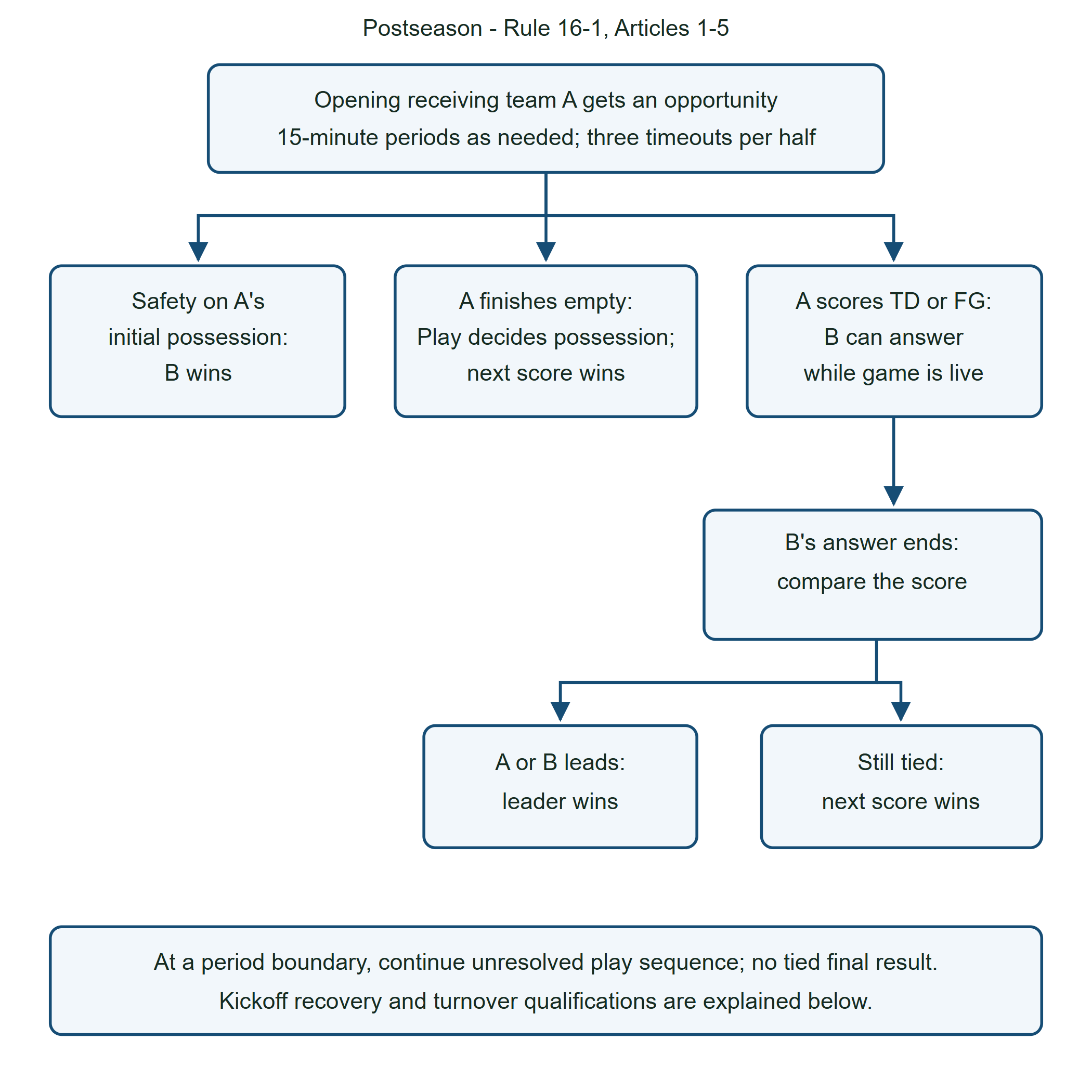
The opening scoring branches work the same way, but postseason overtime has no tied final outcome. If a period ends while the opening exchange is still unresolved, the game continues into another period. A team still entitled to finish its initial possession retains that chance. The first-to-second transition continues the same game and the same opening exchange. Rule 16-1-4(i) provides another coin toss if play continues past the fourth overtime period.
| State after A’s opening opportunity | Who acts next? | Decision |
|---|---|---|
| B scores a safety during A’s initial possession | No answering drive is required | B wins under the initial-possession safety exception (Arts. 3(a), 4(a)). |
| A finishes without scoring | The team entitled to the ball after the play | The next score wins (Arts. 3(c), 4(c)). In regular season the period can still expire tied (Art. 3(d)). |
| A makes a field goal | B has an answering opportunity while the game remains live | B can take the lead with a touchdown or tie with a field goal. An empty answer leaves A ahead (Arts. 3(b)–(d), 4(b)–(d)). |
| A scores a touchdown and completes its try sequence | B has an answering opportunity while the game remains live | Compare the full scores after the answer and any applicable try. A lead wins; a tie moves to next-score-wins (Arts. 3(b)–(d), 4(b)–(d)). |
| Both opening opportunities are complete and the score is tied | The team next entitled to the ball | Any subsequent score wins (Arts. 3(c), 4(c)); the regular-season clock can instead produce a tie (Art. 3(d)). |
The same score can produce different endings
Start tied 20-20. A takes the opening kickoff, scores a touchdown and makes its kick try, moving ahead 27-20. B then has the ball but has not scored when the overtime clock runs out.
| Mode | Clock event | Score and next action |
|---|---|---|
| Regular season | The one 10-minute period is used up; the applicable final play is over | A wins 27-20. B does not receive extra time to finish its opening possession. |
| Postseason | The first 15-minute overtime period ends during B’s initial possession | A still leads 27-20, but the game continues. B retains its initial opportunity into the next period. |
Now change the regular-season example: neither team scores, the final applicable play ends, and the 10-minute period expires at 20-20. The final result is a tie. The clock can also prevent a second opening opportunity from beginning. Having an opening-opportunity framework is different from having unlimited time to complete it.
Two details that change the branch
A kickoff counts as an opportunity. That includes a legal recovery by the kicking team. If B legally recovers the opening kickoff, do not treat A as still waiting for a guaranteed conventional offensive drive. A’s opportunity has been counted; with no opening score by A, the next-score condition applies. Article 5(c) defines the kickoff opportunity.
A turnover during B’s answer is not a universal immediate whistle. When A has scored on its opening possession and B then turns the ball over during the second possession, Rule 16-1-5(a) calls for the down to play to its conclusion. Officials enforce fouls that make the down replay, wipe out a score, or qualify as palpably unfair acts. If the opponent fouled before the turnover, B’s initial possession has not legally ended, so enforcement may extend it under Note 2. The result depends on the completed down and the applicable enforcement.
What to watch before the next snap
First identify the mode: regular season or postseason. Then ask whether the opening exchange is still in progress, whether the score is tied and how much time remains in this period. That sequence explains why a team can kick a field goal without ending one game, yet win immediately with a field goal later in the same overtime.
The controlling source is the 2026 NFL rulebook, Rule 16, Section 1, Articles 1-5, with Rule 4 supplying the applicable timing rules. The NFL’s 2026 rulebook index provides the official online entry point. Every tree and example here is tied to that edition.