
⏱ Estimated reading time: 4 min read
The NFL Draft connects three separate decisions: whether a player is eligible, where a selection belongs in the order and which eligible player the club owning that pick chooses. For the 2026 NFL Draft, keep those steps separate. An eligible prospect is not automatically selected, and a club’s original draft position does not prove it still owns that pick.
The process below uses hypothetical clubs and one approved eligible prospect. It explains the rules without predicting a transaction or presenting a live pick order.
Who is eligible for the NFL Draft?
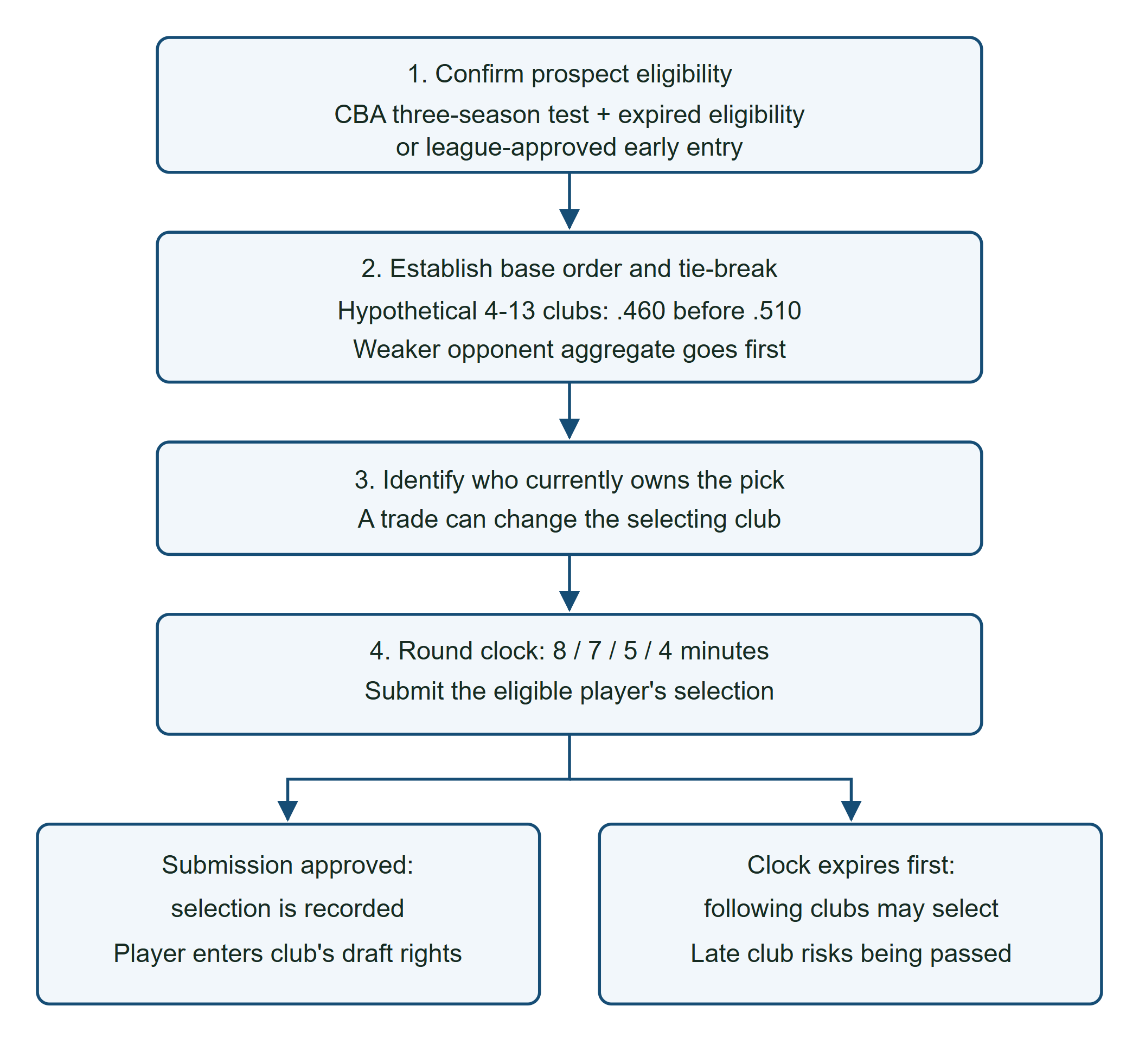
The CBA requires three NFL regular seasons to have begun and ended after the player’s high school graduation or the graduation of the class he entered with, whichever occurred first (Article 6, Section 2(b)). A prospect must also have exhausted his college eligibility or received league approval for early entry. Those are separate checks.
In this example, Prospect P meets the three-season requirement and still has college eligibility, but has received the required early-entry approval. P is therefore available for the hypothetical selection. A player in the same school year without that approval cannot simply be substituted into this example on the assumption that talent establishes eligibility.
How the base draft order is established
Non-playoff teams are ordered by their records, with the weaker record selecting earlier. Playoff teams are grouped by the round in which they were eliminated, then ordered by reverse record within the applicable group. The Super Bowl runner-up has base position 31 and the winner position 32, before trades or other changes to ownership.
This is draft order, not playoff seeding. A playoff seed determines the tournament’s structure; draft order uses its own record, elimination-group and tie-breaking rules. Do not carry a playoff seed directly onto a draft board.
| Club | Record | Opponents’ aggregate winning percentage | Relative order |
|---|---|---|---|
| A | 4-13 | .460 | Earlier |
| B | 4-13 | .510 | Later |
Club A’s weaker strength of schedule, .460 rather than .510, puts it ahead in this example. Those figures are invented solely to demonstrate the rule. They do not establish either club’s exact overall pick because the rest of the league’s order is not part of the model. If that comparison were also tied, further applicable tie-breakers would be needed.
From the order to an approved pick
| Round | Time for a selection |
|---|---|
| 1 | 8 minutes |
| 2 | 7 minutes |
| 3 through 6 | 5 minutes |
| 7 | 4 minutes |
Assume A still owns its pick when its turn arrives. A chooses P, submits the selection and receives approval through the draft process. That records P as A’s selection. Selection gives the club draft rights under the applicable rules; it is not the same event as signing a contract or earning an active-roster place.
What if the pick is traded or the clock expires?
Trade branch: A trades that selection to hypothetical Club C through the approved process. C now owns the pick and can submit P while P remains available. The original order explains where the selection came from; the current ownership explains which club makes it. A traded pick is not a second selection for the original owner.
Expired-clock branch: A does not get its selection in on time. Following clubs may select, so A risks being passed. The missed clock does not automatically mean A has permanently forfeited the pick, but its delay can cost it the player it wanted. If B then selects P before A completes a selection, A cannot later take that same already-selected prospect.
These are alternative paths. In the ordinary approved-selection path P goes to A; in the trade path he may go to C; in the missed-clock path he may be taken by B. The model does not assign P to several teams at once.
Why there can be additional picks
The compensatory free-agent system can award 32 compensatory selections. It evaluates qualifying net losses, rather than giving a pick for every player who leaves. A club’s qualifying departures and additions therefore need to be considered together under the mechanism.
Those compensatory free-agent picks should not be confused with every other special selection category. Nor does “32 teams” mean the final draft must contain exactly 32 selections in every round. This guide does not enumerate the actual 2026 pick list or import a supplemental or expansion procedure as a current ordinary-draft rule.
The controlling process reference is the NFL’s Draft Rules page. The Cowboys’ 2026 draft material, “The Draft” section supplies edition-specific context, including the round clocks. Article 6 of the NFL-NFLPA collective bargaining agreement is the relevant labor-agreement reference for draft rights. Read each figure here as a 2026 rule or a clearly labeled hypothetical, rather than a forecast of an actual selection.