
⏱ Estimated reading time: 5 min read
American football advances through a series of plays called downs. The offense normally has four downs to gain 10 yards. Reaching that line earns a new set of downs; reaching the opponent’s end zone with the ball scores a touchdown. The defense tries to stop that progress, take the ball away or force the offense to give up possession.
For a first game, follow three things between snaps: where the ball is, which down comes next and how far the offense must go. That small scoreboard phrase, such as 2nd-and-6, gives you the immediate problem each team is trying to solve.
Read the down and distance
1st-and-10 at the offense’s 25 means the offense is starting its first down and needs 10 yards to reach its line to gain, its own 35. The line of scrimmage is the starting line for the next play. The line to gain is the target for a new first down. They are different lines.
A scrimmage play begins with the snap. A run can gain or lose yards. A completed pass can advance the ball. A legal forward pass that falls incomplete ends that down without moving the ball forward; the next down starts at the previous spot in this ordinary example. Penalties, turnovers and other special situations can change that sequence, so the example below deliberately excludes them.
One possession, from the 25 to a touchdown
Team A starts with zero points at its own 25. The four scrimmage plays below happen in order. There is no missing gain between the first down at the 37 and the touchdown run.
| Before the play | What happens | Result and next situation |
|---|---|---|
| 1st-and-10, A’s 25 | A runs for 4 yards | Ball at A’s 29; 2nd-and-6. The target remains A’s 35. |
| 2nd-and-6, A’s 29 | A throws an incomplete legal forward pass | Ball stays at A’s 29; 3rd-and-6. |
| 3rd-and-6, A’s 29 | A completes a pass for 8 yards | Ball at A’s 37; 1st-and-10. The new target is A’s 47. |
| 1st-and-10, A’s 37 | A runs 63 yards, untouched, into the opponent’s end zone | Touchdown. A adds 6 points; the possession has reached its scoring result. |
| Try following the touchdown | A’s extra-point kick is good | A adds 1 point. Its total rises from 6 to 7. |
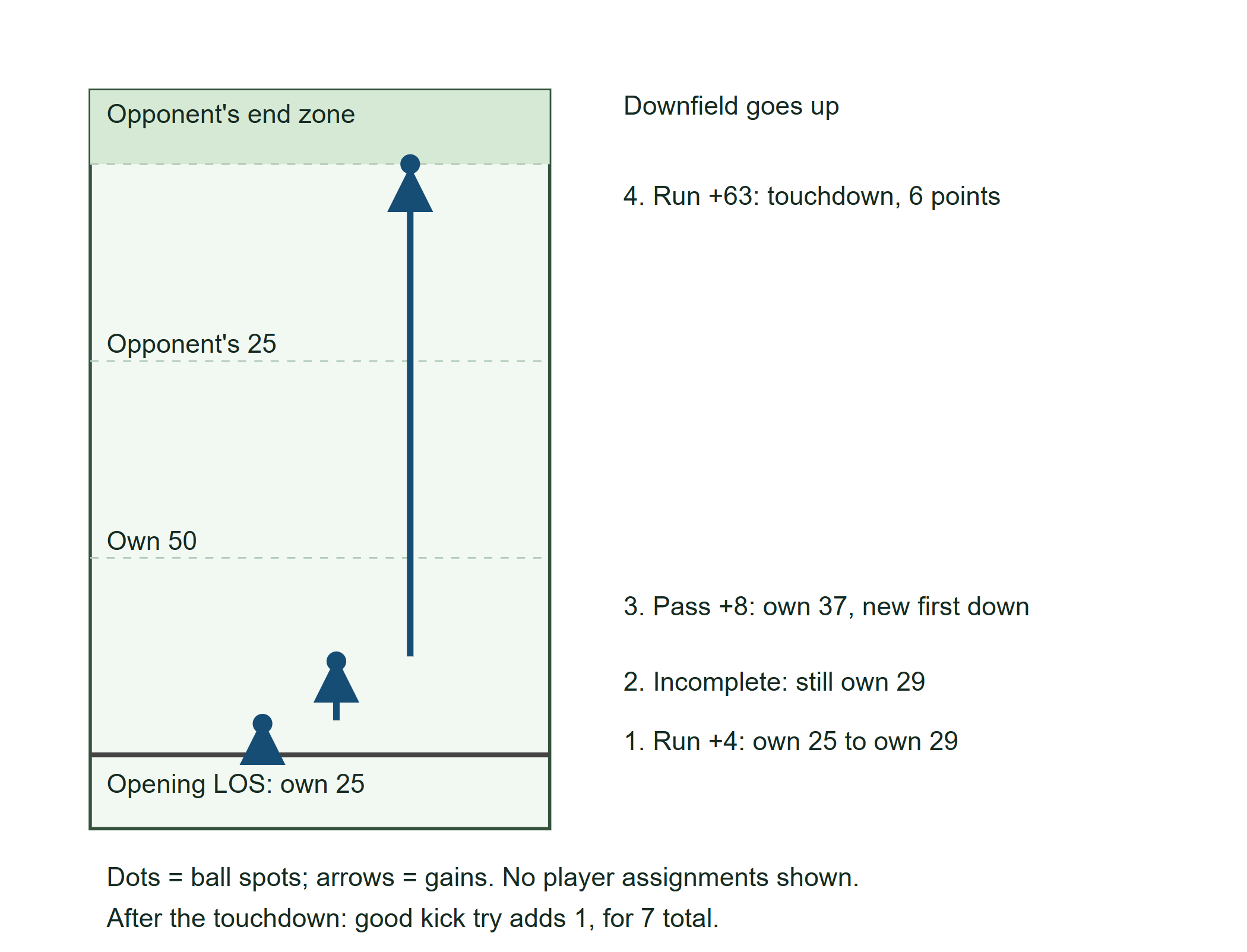
The 8-yard completion is especially useful to watch. It gains more than the 6 yards still needed, so the offense keeps the extra 2 yards and measures its next 10-yard target from the new spot. A first down does not send the ball back to the old target.
What happens on fourth down?
Suppose a different possession reaches 4th-and-2 at the offense’s 40. The target is its 42. If a normal inbounds run ends at its 41, with no penalty or other complication, the offense has fallen a yard short. The opponent takes over at that dead-ball spot, the old offense’s 41. Viewed from the new offense’s direction, that is the opponent’s 41.
That is why teams often use fourth down to punt instead of trying for the line to gain. A punt gives the opponent an opportunity to possess the ball farther downfield, trading possession for field position. It does not guarantee a particular final spot: the kick and what happens afterward determine that. Going for the first down keeps the chance to continue the drive but risks giving the opponent a shorter field.
Goal-to-go and the scoring menu
When the goal line is closer than the usual 10-yard target for a new series, the situation is first-and-goal. From the opponent’s 7, for example, the goal line is the target. A gain to the 3 normally creates 2nd-and-goal at the 3, not another first down merely for moving closer.
| Scoring play | Points | What to recognize |
|---|---|---|
| Touchdown | 6 | The scoring team reaches the opponent’s end zone under the touchdown rules. |
| Successful kick try | 1 | A kick for one point following a touchdown. |
| Touchdown on a try | 2 | The two-point alternative to the kick try. |
| Field goal | 3 | A successful field-goal kick during ordinary play. |
| Safety in ordinary play | 2 | A safety scores for the opponent of the team responsible under the safety rules. |
Quarters, clocks and the next snap
NFL regulation consists of four 15-minute quarters. The game clock tracks time within a period; the play clock governs how long the offense has to begin its next play. Those clocks serve different purposes, and a dead ball does not always mean that the game clock stays stopped until the snap. Exact starts, stops and exceptions belong to the timing rules.
After each play, check the official spot, the down and the distance before judging the next decision. A short gain might be a success on 3rd-and-1 and a problem on 3rd-and-12. The same field position can call for a different choice depending on the score and time remaining.
This guide follows the ordinary rules in the 2026 NFL rulebook, especially Rules 3, 4, 7, 8, 9 and 11. Overtime has its own possession and ending rules in Rule 16; the regular sequence above should not be used to infer every overtime outcome.